
Offline-First Android System Design: A Complete Guide - 2

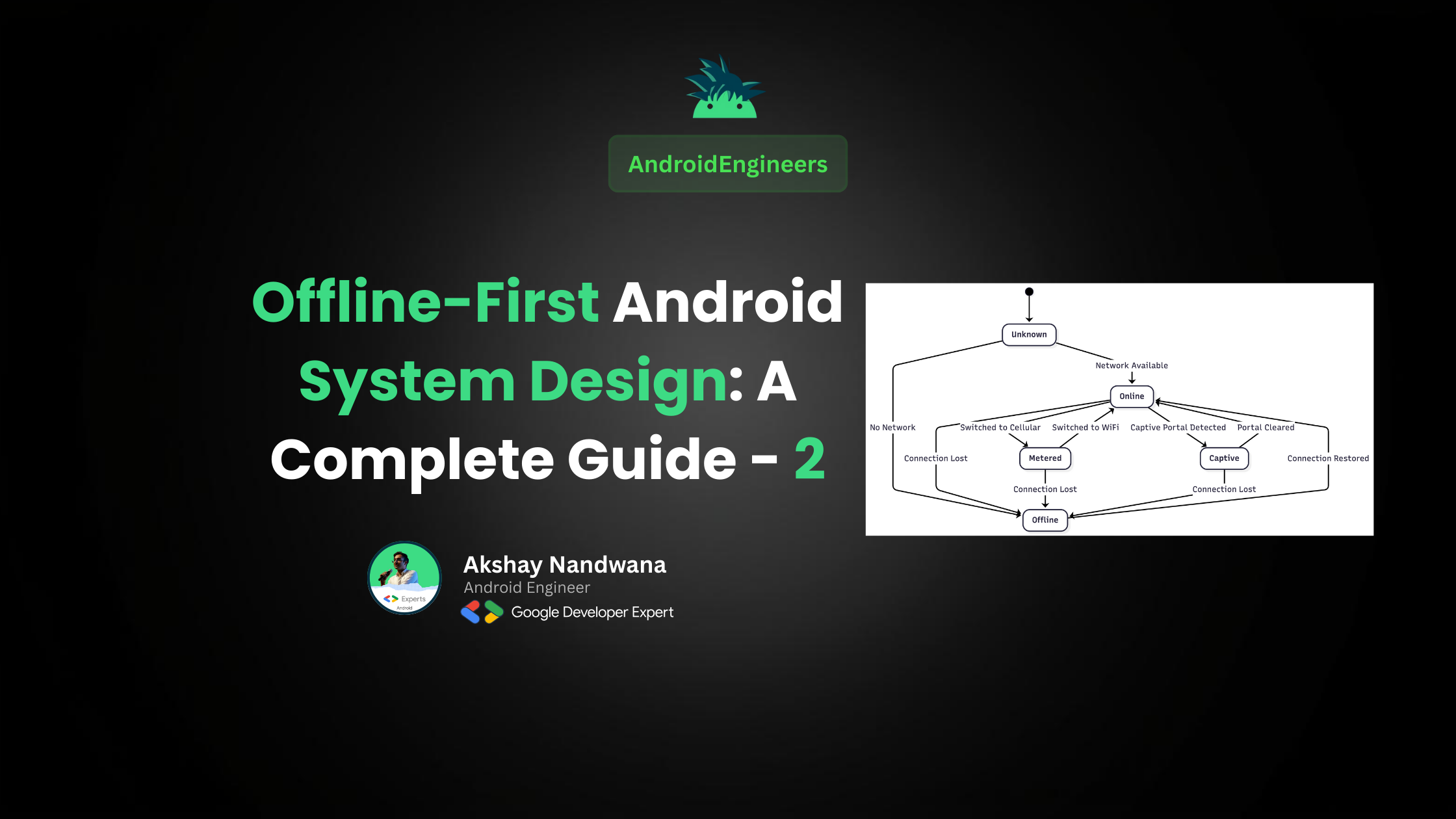
A comprehensive deep-dive into building Android applications that work seamlessly offline, covering architecture patterns, synchronization strategies, edge cases, and real-world implementation approaches.
Table of Contents
Part - 1
Introduction to Offline-First
Core Architecture Patterns
Data Synchronization Strategies
Conflict Resolution
Part - 2
Caching Architecture
Network State Management
Background Sync & WorkManager
Edge Cases & Error Handling
Testing Offline Scenarios
Best Practices & Patterns
Caching Architecture
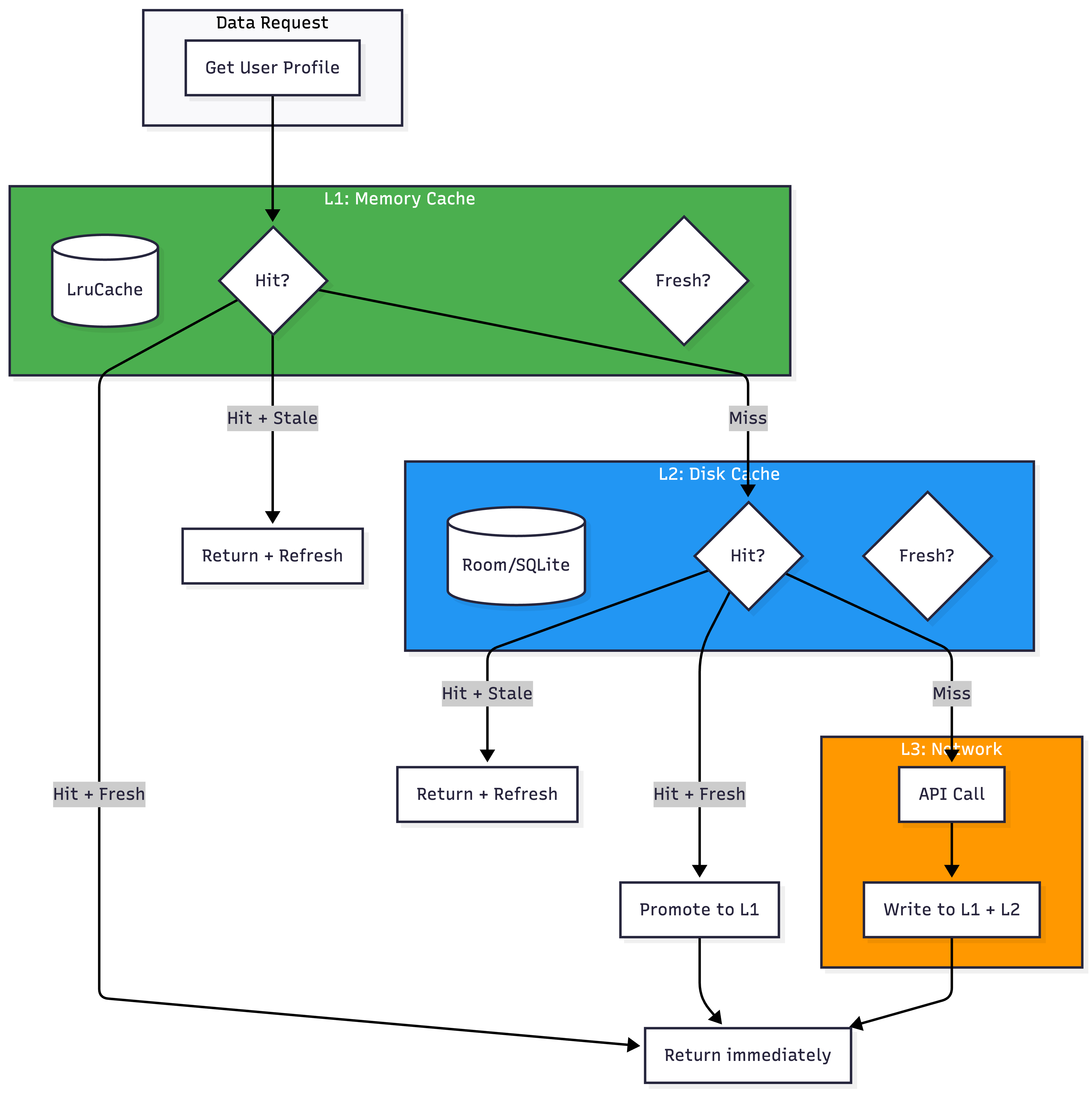
Multi-Layer Cache Design
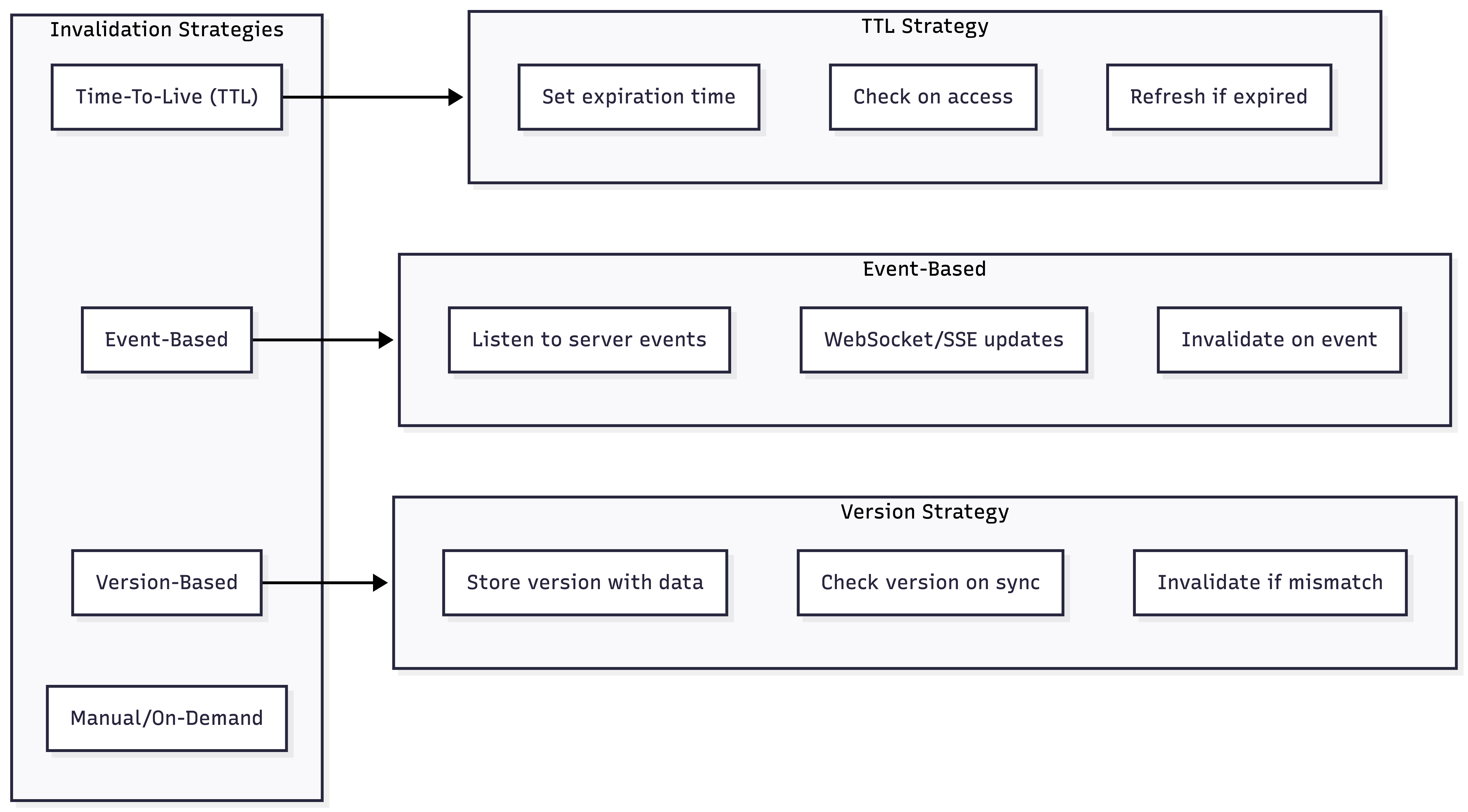
Cache Invalidation Strategies
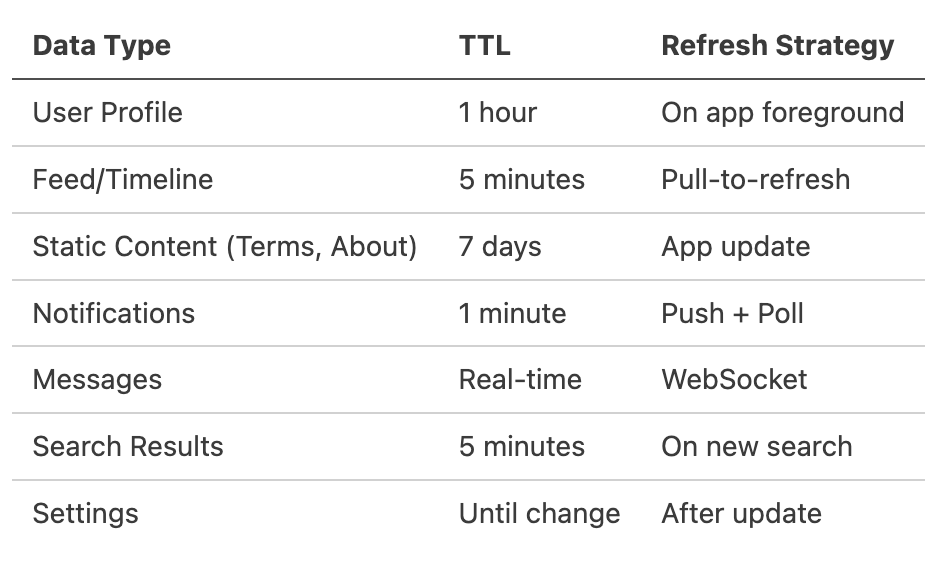
Cache Freshness Policies
Stale-While-Revalidate Pattern
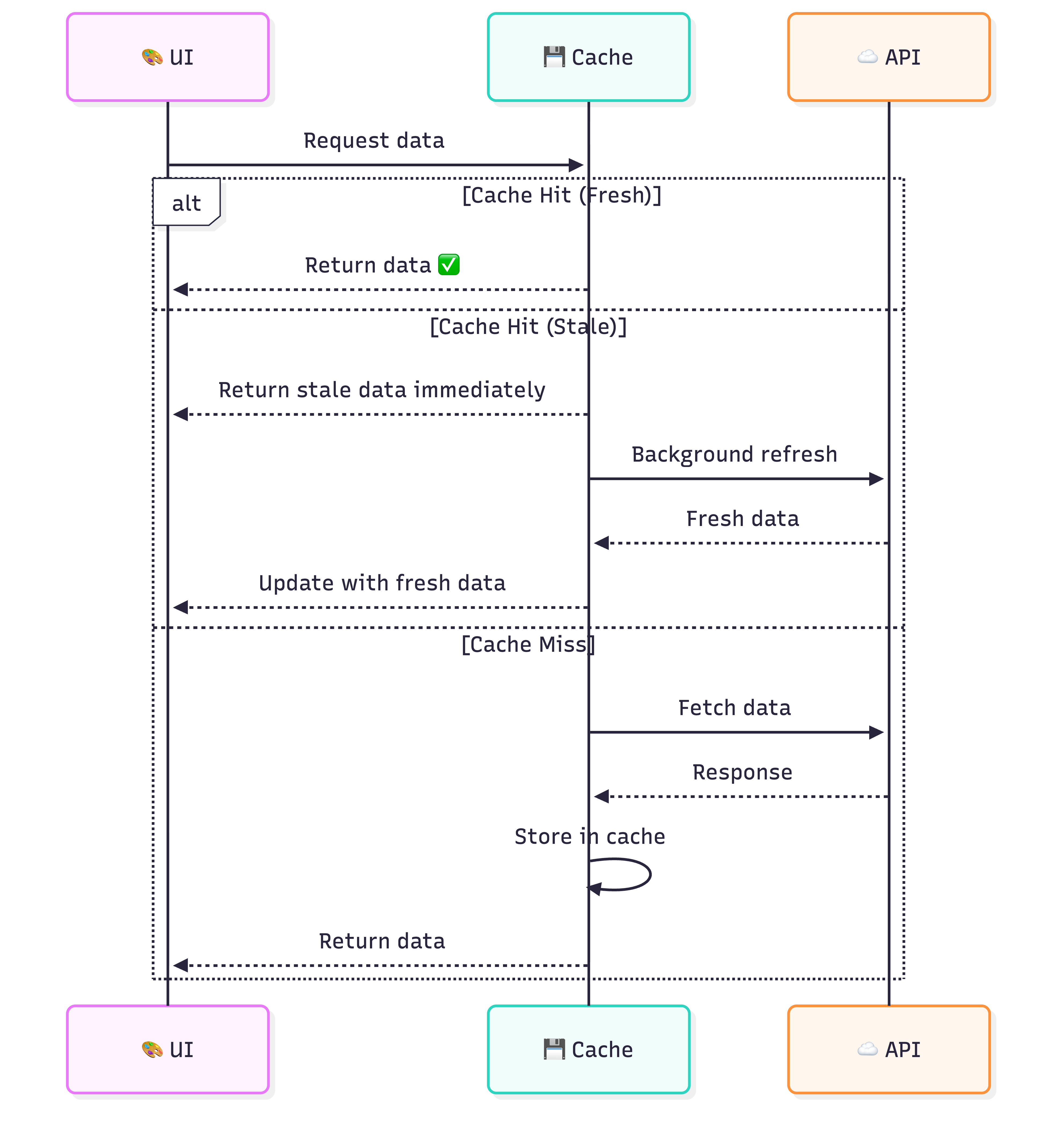
// Cache-Control inspired freshness check
data class CachedData<T>(
    val data: T,
    val cachedAt: Long,
    val maxAge: Long,           // Fresh for this duration
    val staleWhileRevalidate: Long  // Can serve stale for this additional duration
) {
    val isFresh: Boolean
        get() = System.currentTimeMillis() - cachedAt < maxAge

    val isStaleButUsable: Boolean
        get() {
            val age = System.currentTimeMillis() - cachedAt
            return age >= maxAge && age < (maxAge + staleWhileRevalidate)
        }

    val isExpired: Boolean
        get() = System.currentTimeMillis() - cachedAt >= (maxAge + staleWhileRevalidate)
}
Network State Management
Connectivity Observation
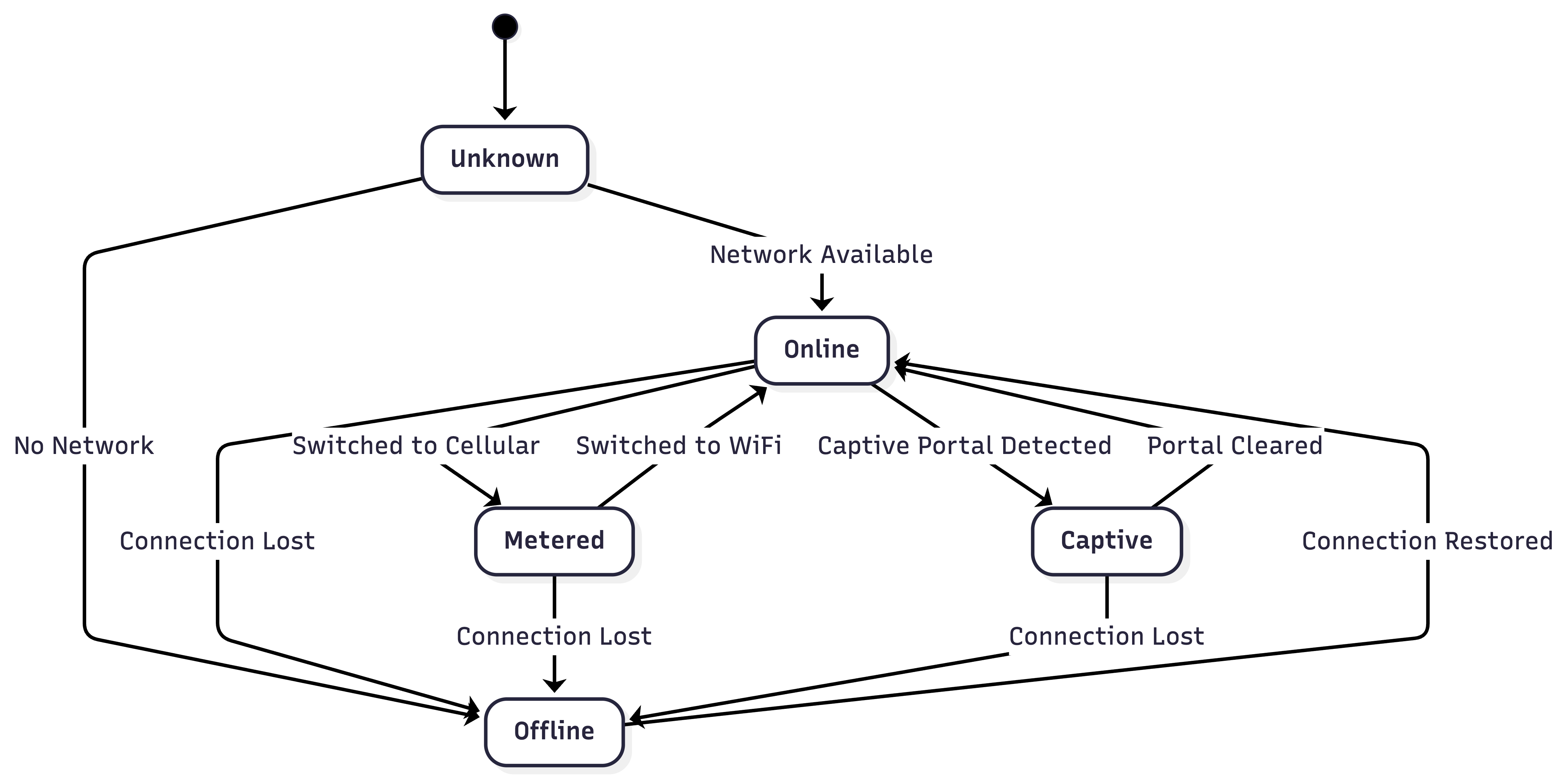
Network State Types
sealed class NetworkState {
    object Unknown : NetworkState()

    data class Online(
        val type: ConnectionType,
        val isMetered: Boolean,
        val downstreamBandwidthKbps: Int
    ) : NetworkState()

    object Offline : NetworkState()

    data class CaptivePortal(
        val portalUrl: String?
    ) : NetworkState()
}

enum class ConnectionType {
    WIFI, CELLULAR_5G, CELLULAR_4G, CELLULAR_3G, CELLULAR_2G, ETHERNET, UNKNOWN
}
Adaptive Behavior Based on Network
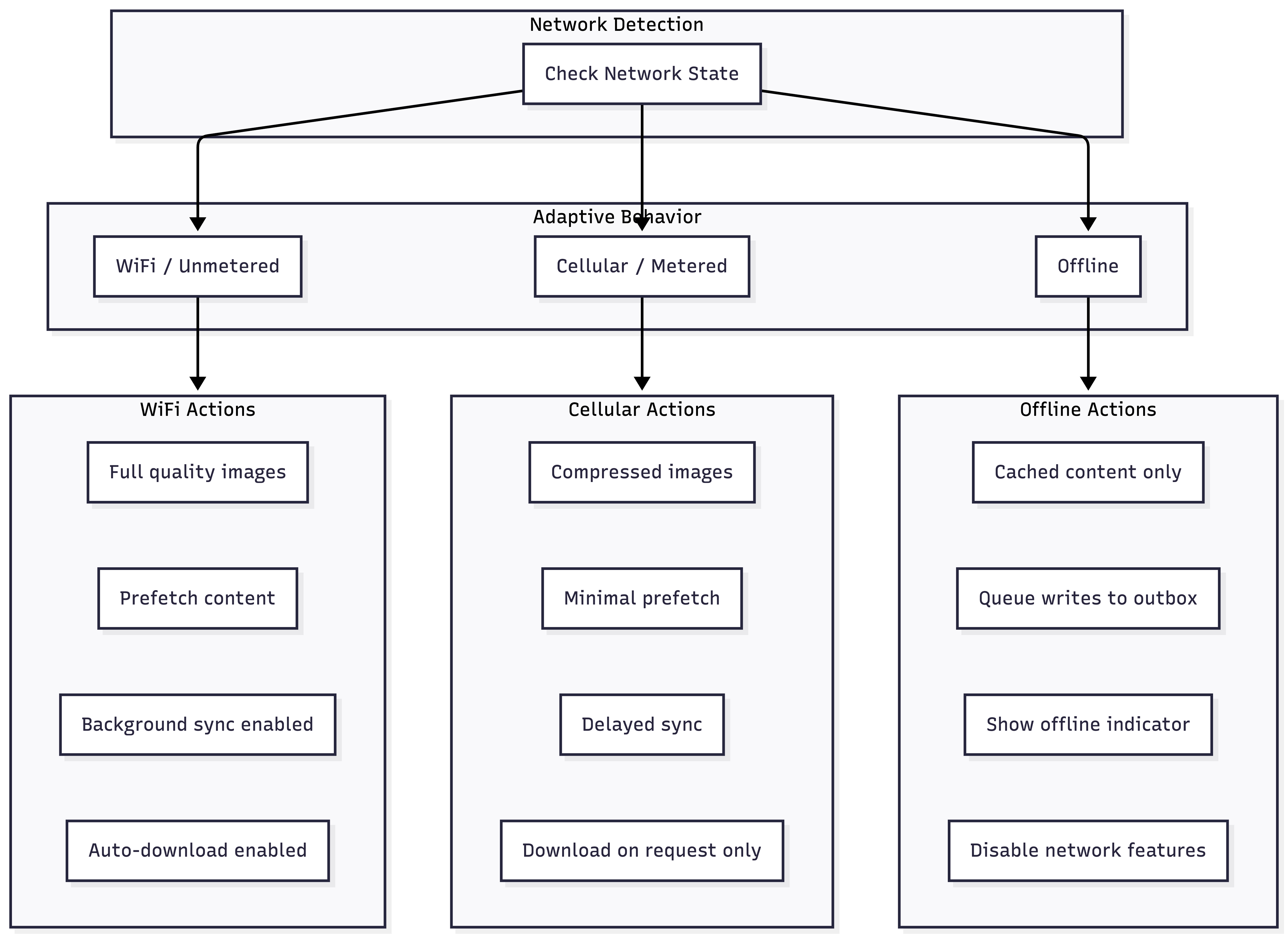
Connectivity Monitoring Implementation
// Observing network state changes
class NetworkMonitor @Inject constructor(
    @ApplicationContext private val context: Context
) {
    private val connectivityManager =
        context.getSystemService<ConnectivityManager>()

    val networkState: Flow<NetworkState> = callbackFlow {
        val callback = object : ConnectivityManager.NetworkCallback() {
            override fun onAvailable(network: Network) {
                trySend(determineNetworkState())
            }

            override fun onLost(network: Network) {
                trySend(NetworkState.Offline)
            }

            override fun onCapabilitiesChanged(
                network: Network,
                capabilities: NetworkCapabilities
            ) {
                trySend(determineNetworkState(capabilities))
            }
        }

        val request = NetworkRequest.Builder()
            .addCapability(NetworkCapabilities.NET_CAPABILITY_INTERNET)
            .build()

        connectivityManager?.registerNetworkCallback(request, callback)

        // Emit initial state
        trySend(determineNetworkState())

        awaitClose {
            connectivityManager?.unregisterNetworkCallback(callback)
        }
    }.distinctUntilChanged()

    private fun determineNetworkState(
        capabilities: NetworkCapabilities? = null
    ): NetworkState {
        val caps = capabilities
            ?: connectivityManager?.activeNetwork?.let {
                connectivityManager.getNetworkCapabilities(it)
            }
            ?: return NetworkState.Offline

        // Check for captive portal
        if (!caps.hasCapability(NetworkCapabilities.NET_CAPABILITY_VALIDATED)) {
            return NetworkState.CaptivePortal(null)
        }

        return NetworkState.Online(
            type = determineConnectionType(caps),
            isMetered = !caps.hasCapability(
                NetworkCapabilities.NET_CAPABILITY_NOT_METERED
            ),
            downstreamBandwidthKbps = caps.linkDownstreamBandwidthKbps
        )
    }
}
Background Sync & WorkManager
Sync Scheduling Strategy
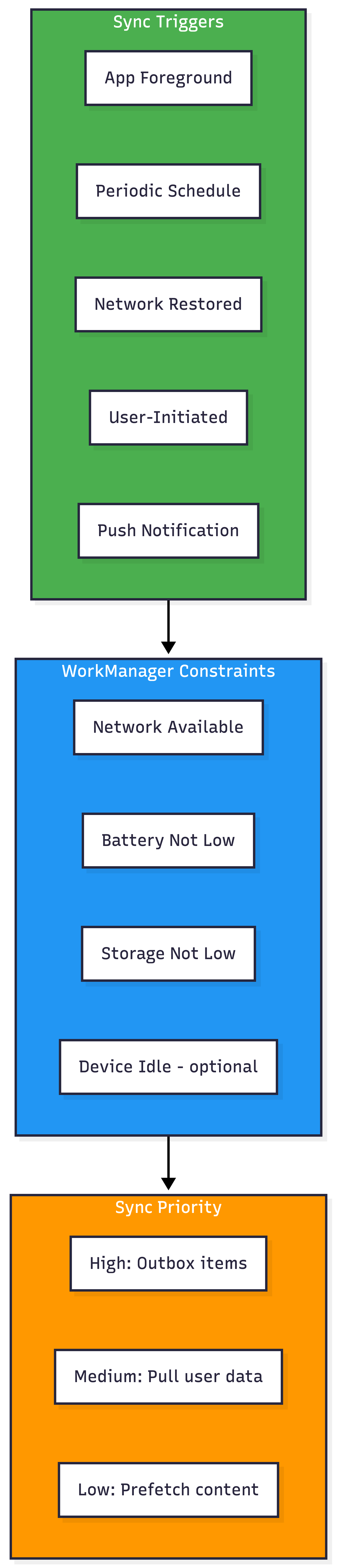
WorkManager Configuration
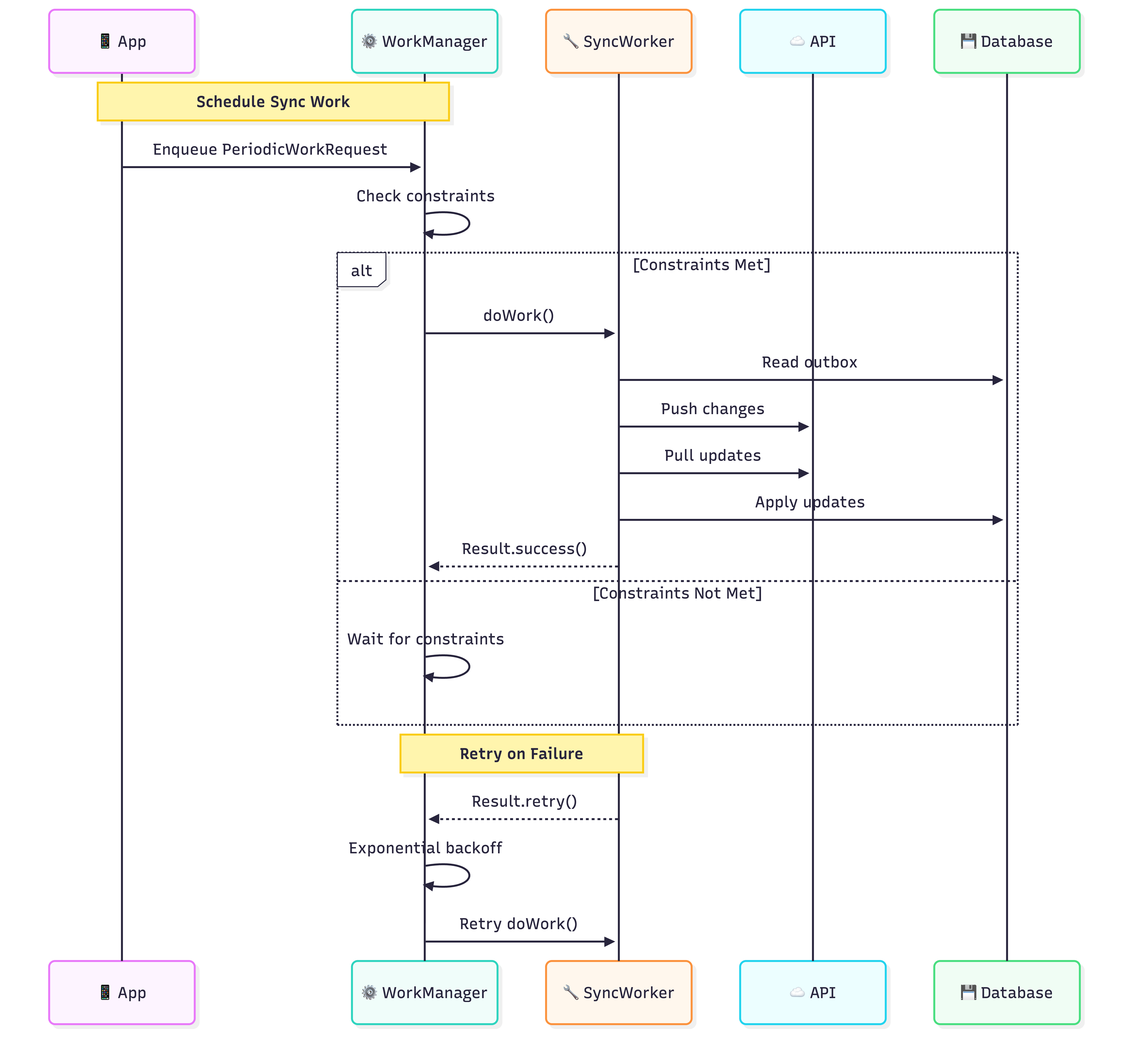
Sync Worker Implementation
@HiltWorker
class SyncWorker @AssistedInject constructor(
    @Assisted context: Context,
    @Assisted params: WorkerParameters,
    private val syncEngine: SyncEngine,
    private val notificationHelper: SyncNotificationHelper
) : CoroutineWorker(context, params) {

    override suspend fun doWork(): Result {
        // Show progress for long-running sync
        setForeground(createForegroundInfo())

        return try {
            val syncResult = syncEngine.performFullSync()

            when {
                syncResult.isSuccess -> {
                    notificationHelper.showSyncComplete(syncResult.itemsSynced)
                    Result.success()
                }
                syncResult.hasConflicts -> {
                    notificationHelper.showConflictsNeedResolution(
                        syncResult.conflicts.size
                    )
                    Result.success() // Still success, conflicts are queued
                }
                syncResult.isPartialFailure -> {
                    // Some items synced, retry for the rest
                    if (runAttemptCount < 3) Result.retry()
                    else Result.success() // Give up on remaining items
                }
                else -> {
                    if (runAttemptCount < 5) Result.retry()
                    else Result.failure()
                }
            }
        } catch (e: Exception) {
            if (runAttemptCount < 3) Result.retry()
            else Result.failure(workDataOf("error" to e.message))
        }
    }

    private fun createForegroundInfo(): ForegroundInfo {
        return ForegroundInfo(
            SYNC_NOTIFICATION_ID,
            notificationHelper.createSyncInProgressNotification()
        )
    }
}

// Scheduling the sync worker
object SyncScheduler {
    fun schedulePeriodicSync(workManager: WorkManager) {
        val constraints = Constraints.Builder()
            .setRequiredNetworkType(NetworkType.CONNECTED)
            .setRequiresBatteryNotLow(true)
            .build()

        val syncRequest = PeriodicWorkRequestBuilder<SyncWorker>(
            repeatInterval = 15,
            repeatIntervalTimeUnit = TimeUnit.MINUTES,
            flexTimeInterval = 5,
            flexTimeIntervalUnit = TimeUnit.MINUTES
        )
            .setConstraints(constraints)
            .setBackoffCriteria(
                BackoffPolicy.EXPONENTIAL,
                WorkRequest.MIN_BACKOFF_MILLIS,
                TimeUnit.MILLISECONDS
            )
            .build()

        workManager.enqueueUniquePeriodicWork(
            "periodic_sync",
            ExistingPeriodicWorkPolicy.KEEP,
            syncRequest
        )
    }

    fun scheduleImmediateSync(workManager: WorkManager) {
        val syncRequest = OneTimeWorkRequestBuilder<SyncWorker>()
            .setConstraints(
                Constraints.Builder()
                    .setRequiredNetworkType(NetworkType.CONNECTED)
                    .build()
            )
            .setExpedited(OutOfQuotaPolicy.RUN_AS_NON_EXPEDITED_WORK_REQUEST)
            .build()

        workManager.enqueueUniqueWork(
            "immediate_sync",
            ExistingWorkPolicy.REPLACE,
            syncRequest
        )
    }
}
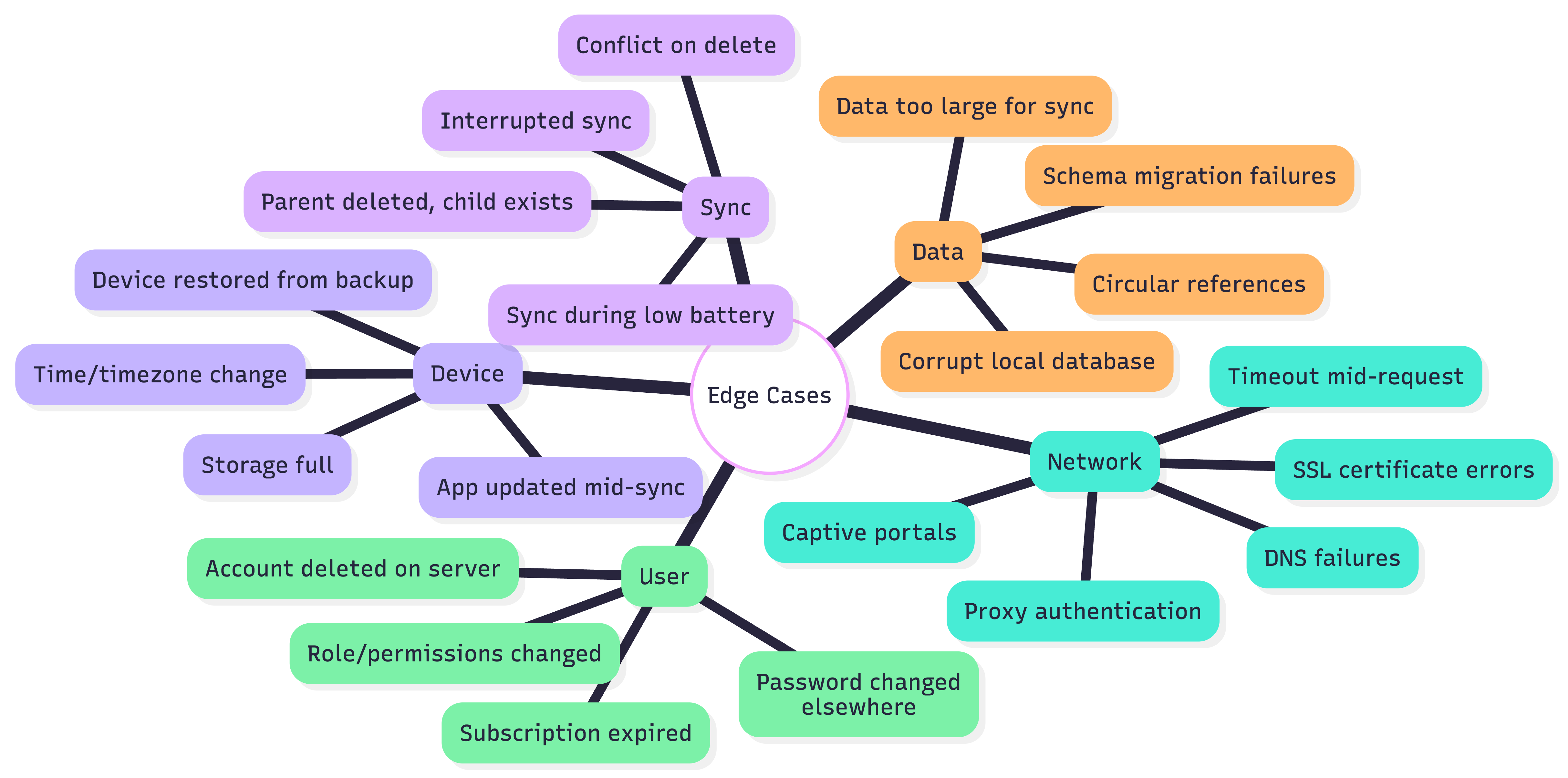
Edge Cases & Error Handling
Complete Edge Case Catalog
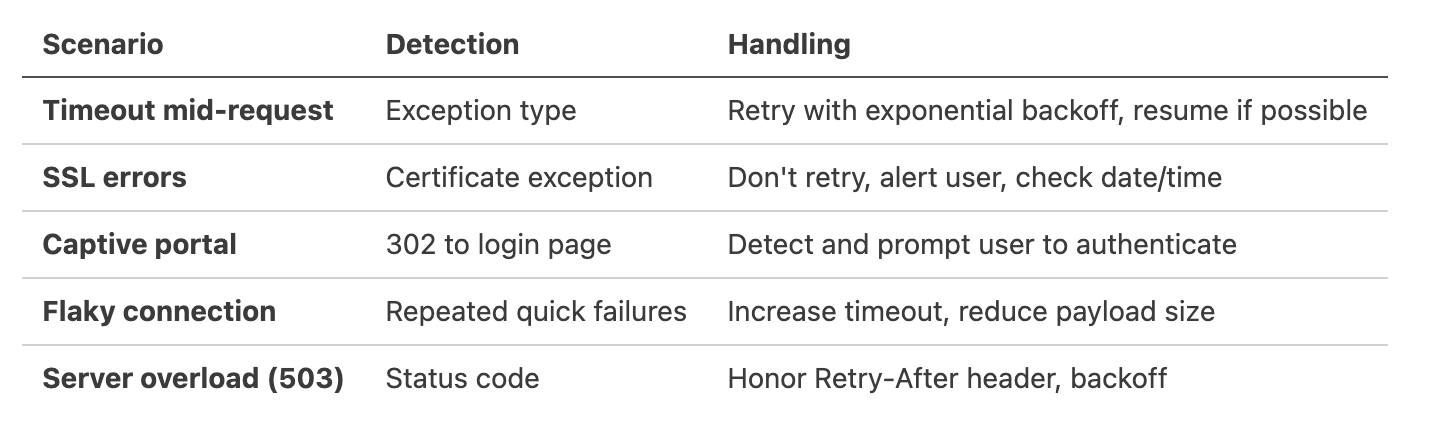
Network Edge Cases
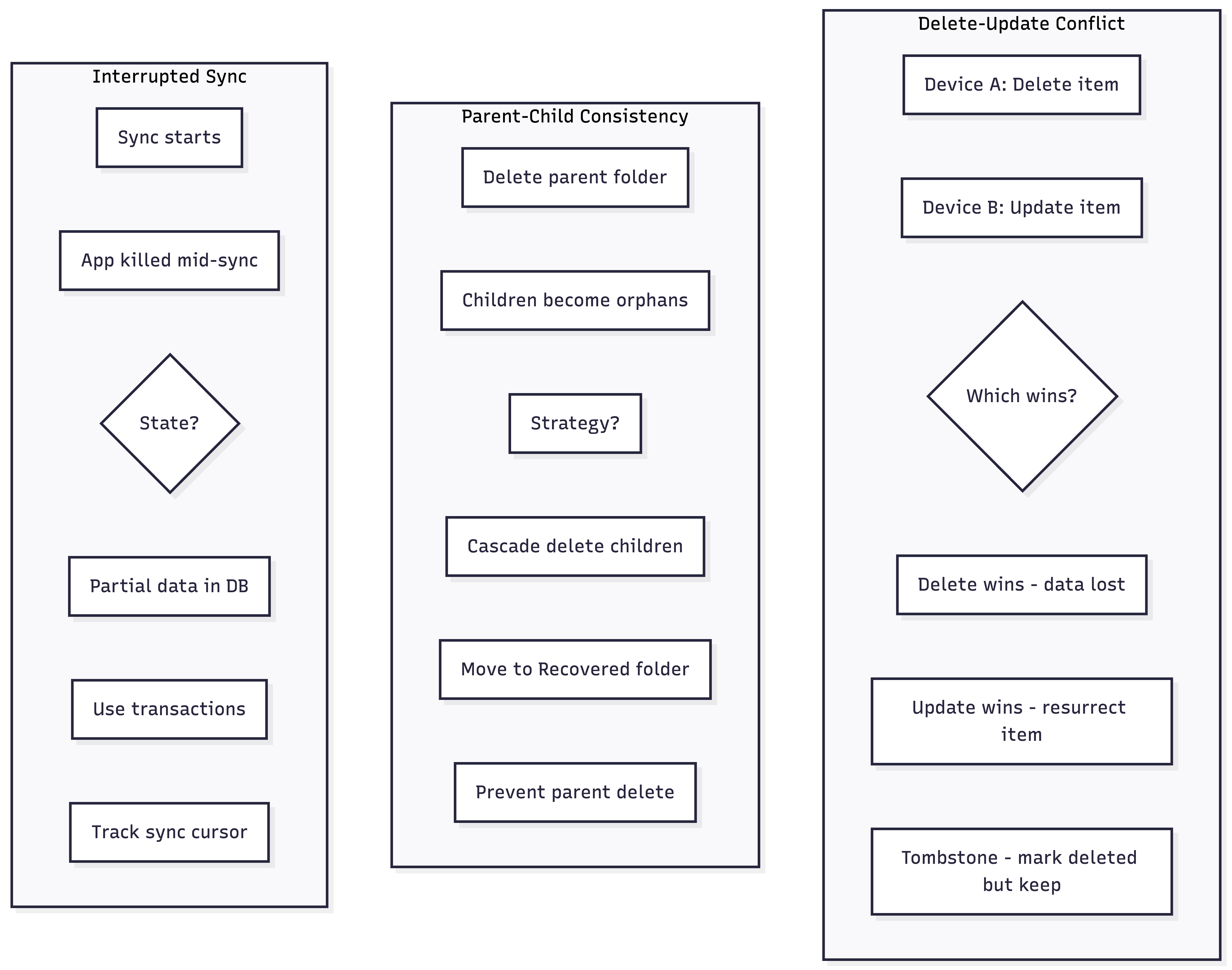
Data Consistency Edge Cases
Storage Edge Cases
// Handling storage pressure
class StorageManager @Inject constructor(
    @ApplicationContext private val context: Context
) {
    fun getAvailableSpace(): Long {
        val stat = StatFs(context.filesDir.path)
        return stat.availableBytes
    }

    fun isStorageLow(): Boolean {
        val available = getAvailableSpace()
        val threshold = 100 * 1024 * 1024 // 100MB
        return available < threshold
    }

    suspend fun freeUpSpace(targetBytes: Long): Boolean {
        var freedBytes = 0L

        // Priority order for deletion
        val deletionCandidates = listOf(
            { clearImageCache() },
            { clearOldSyncLogs() },
            { clearExpiredCacheData() },
            { compactDatabase() },
            // Never auto-delete user content
        )

        for (action in deletionCandidates) {
            if (freedBytes >= targetBytes) break
            freedBytes += action()
        }

        return freedBytes >= targetBytes
    }
}

// Graceful handling when storage is full
suspend fun saveWithStorageCheck(data: Data): Result<Unit> {
    return try {
        if (storageManager.isStorageLow()) {
            val needed = estimateSize(data)
            val freed = storageManager.freeUpSpace(needed)
            if (!freed) {
                return Result.failure(InsufficientStorageException())
            }
        }
        database.save(data)
        Result.success(Unit)
    } catch (e: SQLiteFullException) {
        Result.failure(InsufficientStorageException(e))
    }
}
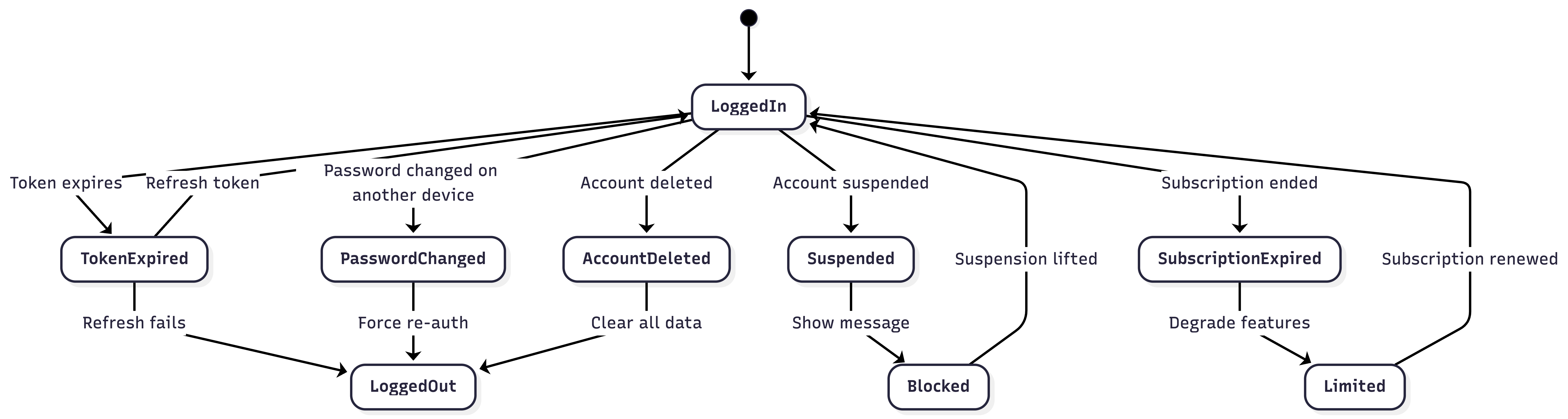
Account State Edge Cases
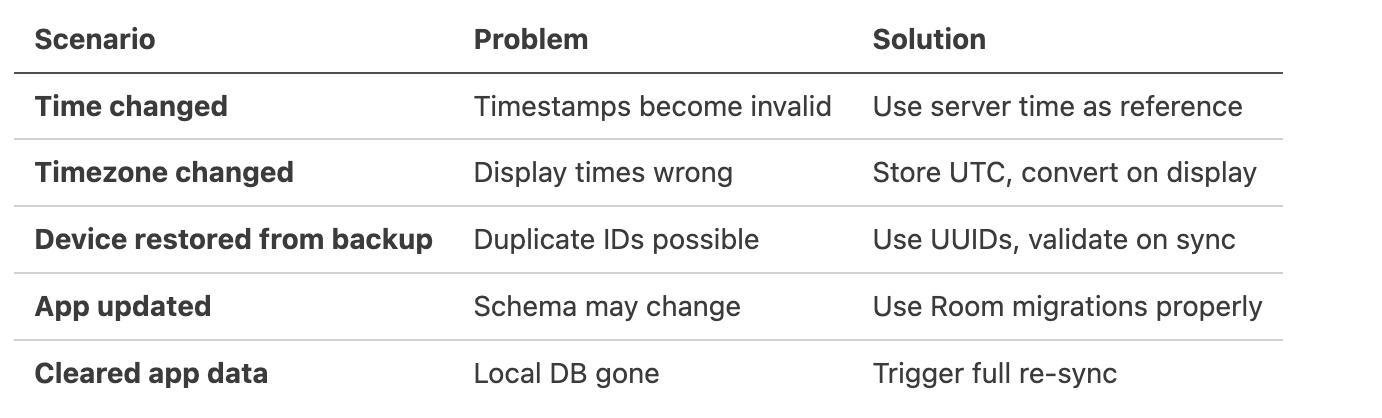
Device State Edge Cases
Testing Offline Scenarios
Test Categories
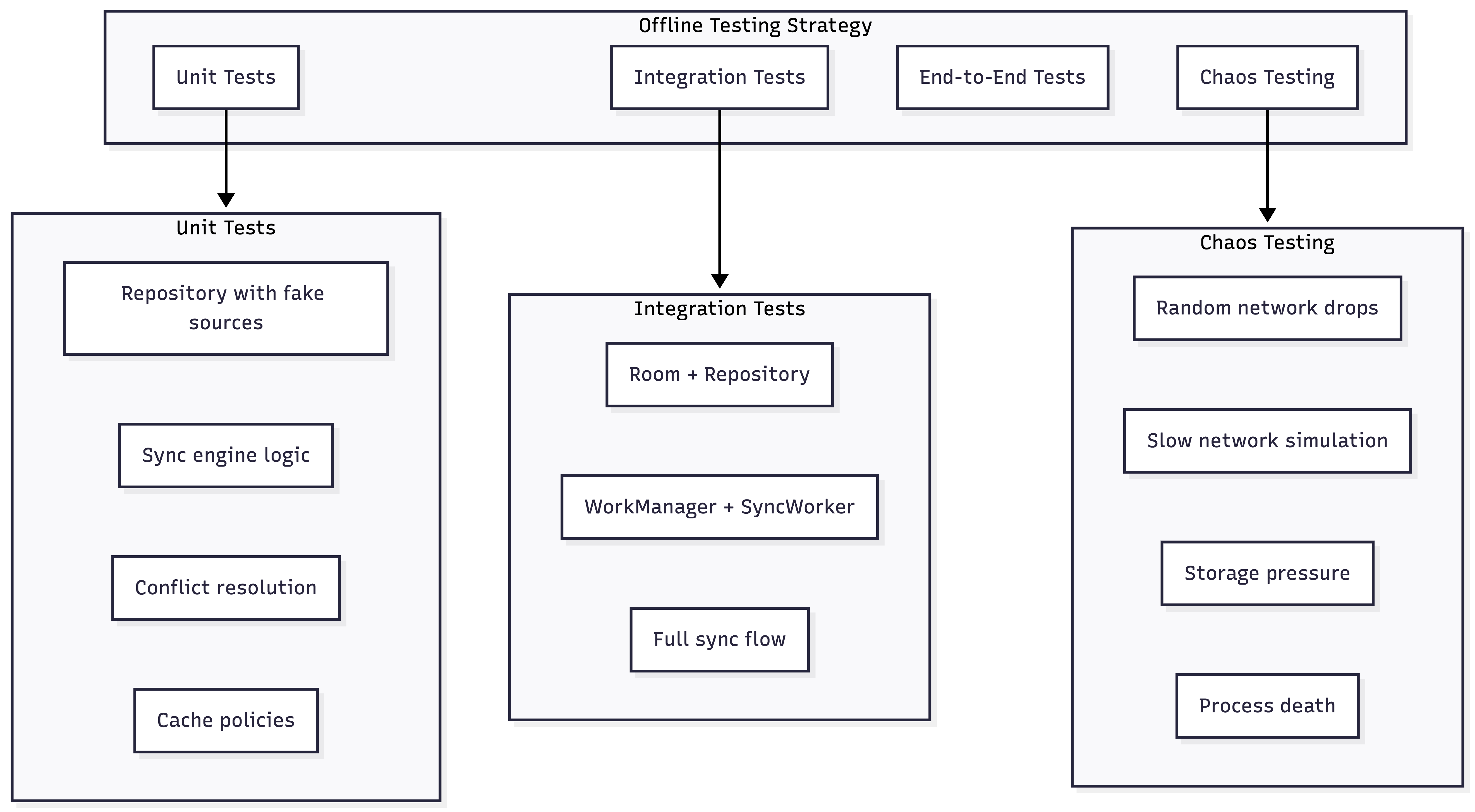
Test Scenarios Checklist
## Network Conditions
- [ ] Complete offline mode
- [ ] Transition from online to offline during operation
- [ ] Transition from offline to online
- [ ] Slow network (simulate 2G/3G)
- [ ] High latency network
- [ ] Intermittent connectivity (flaky)
- [ ] WiFi to cellular transition
- [ ] Airplane mode toggle

## Data Operations
- [ ] Create while offline
- [ ] Update while offline
- [ ] Delete while offline
- [ ] Conflict: same item modified on two devices
- [ ] Conflict: item deleted on one, modified on other
- [ ] Large batch operations offline
- [ ] Sync with thousands of items

## Edge Cases
- [ ] Storage nearly full
- [ ] Process killed during sync
- [ ] App update during offline period
- [ ] Account state changes while offline
- [ ] Clock skew between devices
- [ ] Corrupt cache recovery
Simulating Network Conditions
// Fake network data source for testing
class FakeNetworkDataSource : NetworkDataSource {
    var shouldFail = false
    var latencyMs = 0L
    var failureRate = 0.0  // 0.0 to 1.0

    private val random = Random()

    override suspend fun fetch(): Result<Data> {
        delay(latencyMs)

        if (shouldFail || random.nextDouble() < failureRate) {
            return Result.failure(IOException("Simulated network failure"))
        }

        return Result.success(testData)
    }
}

// Using ADB to test on device
// Simulate offline:
// adb shell svc wifi disable
// adb shell svc data disable

// Simulate slow network:
// adb shell tc qdisc add dev wlan0 root netem delay 500ms

// Simulate packet loss:
// adb shell tc qdisc add dev wlan0 root netem loss 20%
Best Practices & Patterns
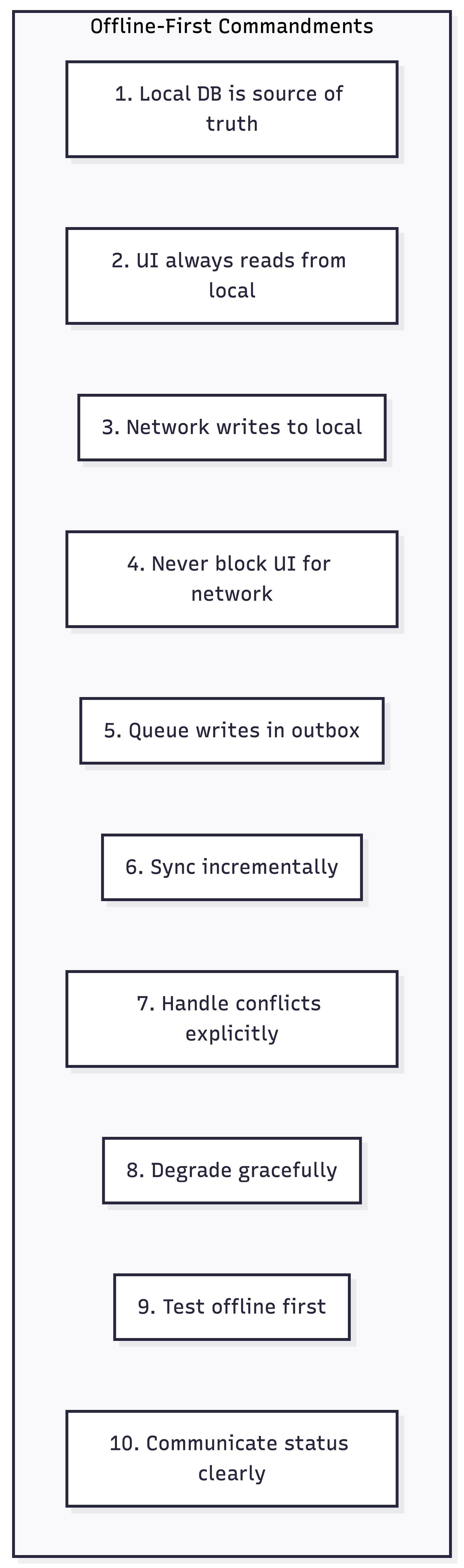
The Ten Commandments of Offline-First
UI Patterns for Offline State
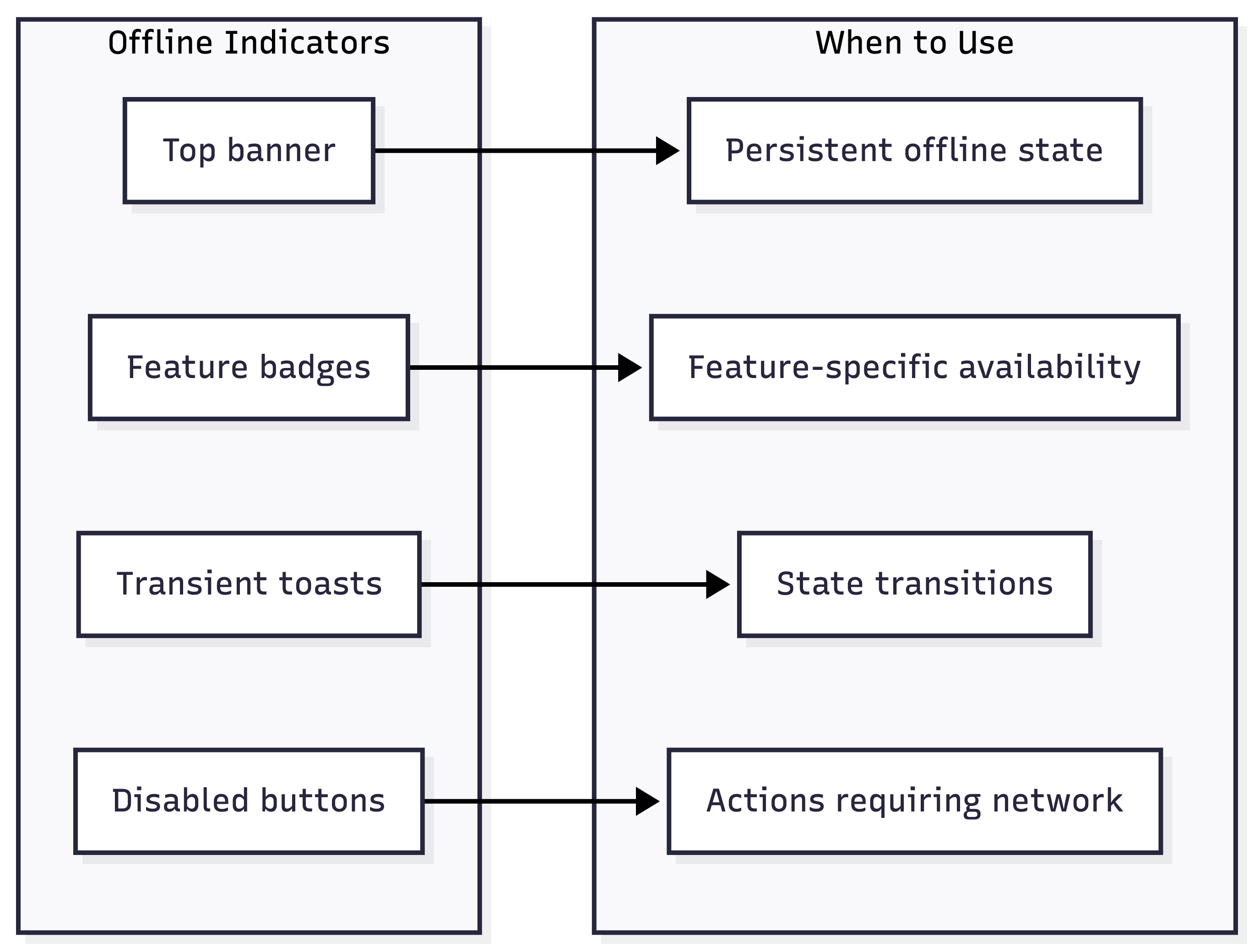
Best Practices for Offline UI:
Show offline status prominently but not intrusively
Indicate which content is cached vs. potentially stale
Disable (don’t hide) features requiring network
Show pending sync count when relevant
Celebrate successful sync completion subtly
Explain why certain features are unavailable
Data Model Patterns
// Every syncable entity should have these fields
interface Syncable {
    val id: String                    // Client-generated UUID
    val serverId: String?             // Server-assigned ID (null until synced)
    val version: Long                 // For conflict detection
    val createdAt: Long               // Local creation timestamp
    val modifiedAt: Long              // Last modification timestamp
    val syncedAt: Long?               // Last successful sync
    val syncStatus: SyncStatus        // Current sync state
}

enum class SyncStatus {
    SYNCED,           // Matches server state
    PENDING_CREATE,   // Created locally, not yet synced
    PENDING_UPDATE,   // Modified locally, not yet synced
    PENDING_DELETE,   // Marked for deletion, not yet synced
    CONFLICT          // Has unresolved conflict
}

// Extension to check if entity needs sync
val Syncable.needsSync: Boolean
    get() = syncStatus != SyncStatus.SYNCED
Architecture Decision Records
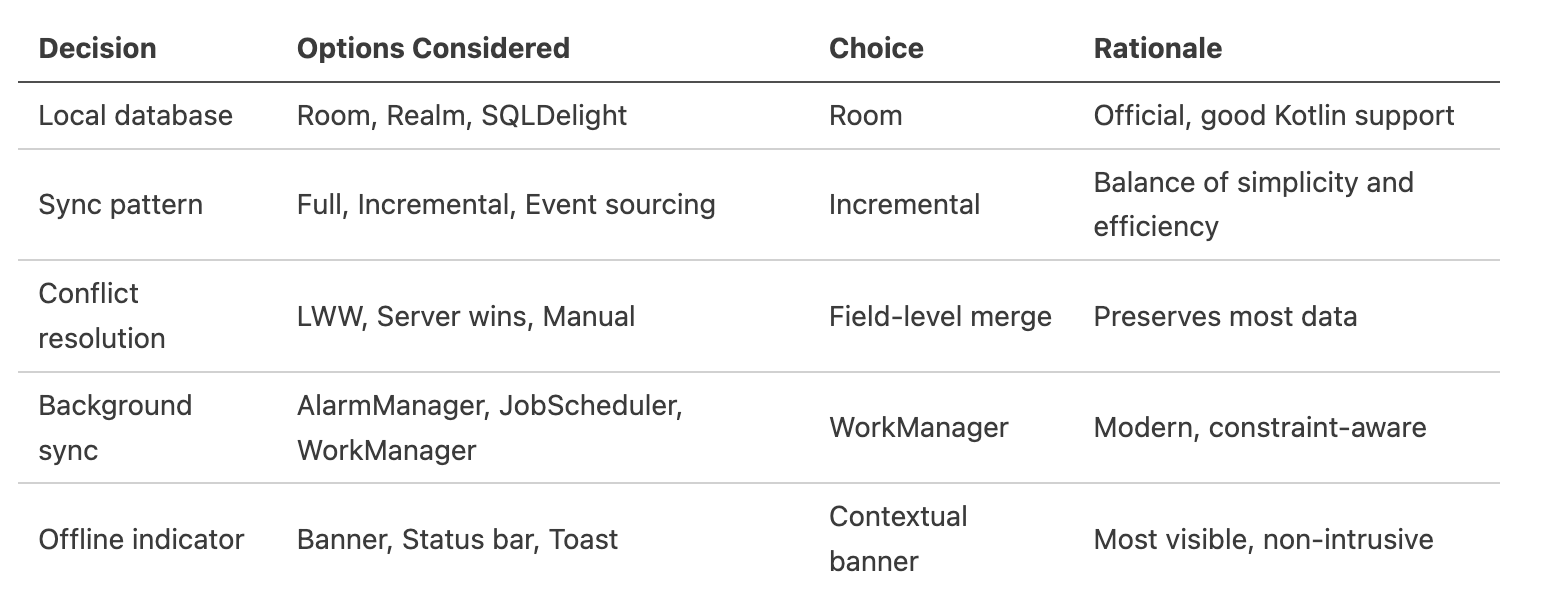
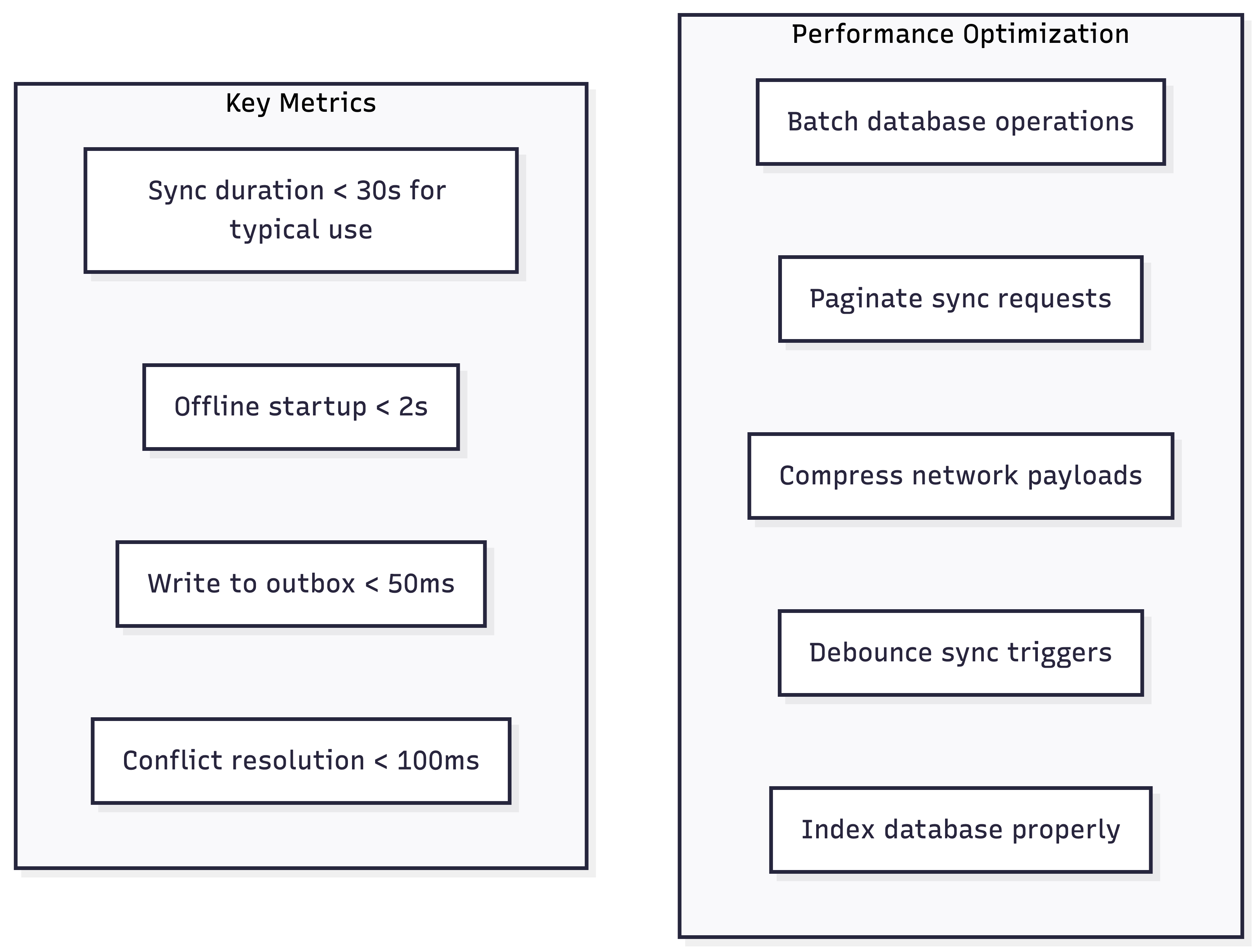
Performance Considerations
Conclusion
The Offline-First Architecture Checklist
## Foundation
- [ ] Room database as source of truth
- [ ] Repository pattern isolating data sources
- [ ] Outbox table for pending operations
- [ ] Sync status on all syncable entities

## Synchronization
- [ ] Incremental sync with tokens/cursors
- [ ] Bidirectional sync (push then pull)
- [ ] Conflict detection mechanism
- [ ] Conflict resolution strategy defined

## Error Handling
- [ ] Retry logic with exponential backoff
- [ ] Graceful degradation for all features
- [ ] Clear error communication to users
- [ ] Automatic recovery where possible

## Background Processing
- [ ] WorkManager for reliable sync
- [ ] Appropriate constraints set
- [ ] Battery and data usage considered
- [ ] Foreground service for long syncs

## User Experience
- [ ] Offline indicator visible
- [ ] Pending changes shown
- [ ] Stale data marked
- [ ] Sync status accessible

## Testing
- [ ] Offline scenarios tested
- [ ] Conflict resolution tested
- [ ] Slow/flaky network tested
- [ ] Edge cases covered
Building offline-first applications requires a fundamental shift in thinking. The network becomes an optimization, not a requirement. The result is applications that feel fast, reliable, and trustworthy—the hallmarks of great mobile software.
“The best network request is the one you never have to make.”