
Job and SupervisorJob in Kotlin Coroutines: A Complete Guide
Mastering Error Handling and Cancellation in Kotlin Coroutines - From Basics to Production-Ready Patterns


Introduction
Kotlin coroutines provide powerful tools for managing asynchronous operations, and at the heart of this system are Job and SupervisorJob. Understanding these concepts is crucial for building robust, fault-tolerant applications. This blog explores their differences, use cases, and best practices.
What is a Job?
A Job is a cancellable task with a lifecycle. Every coroutine has an associated Job that controls its execution. Think of a Job as a handle to the coroutine that allows you to:
Cancel the coroutine
Wait for its completion
Check its state (active, completed, cancelled)
Establish parent-child relationships
Job Lifecycle States
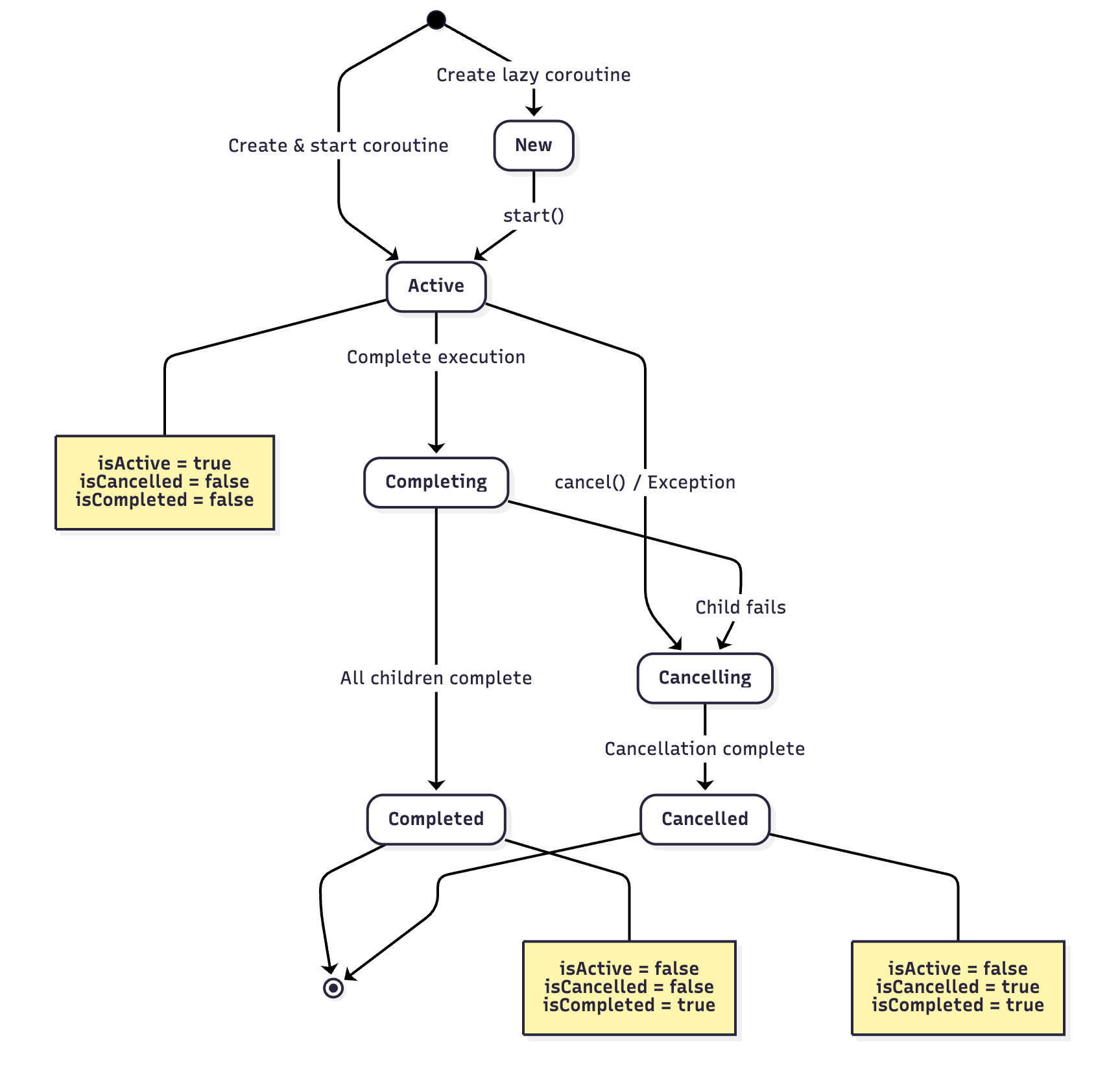
A Job can be in one of several states:
New - Job is created but not yet started (only for lazy coroutines)
Active - Job is running
Completing - Job is finishing but waiting for children
Completed - Job finished successfully
Cancelling - Job is being cancelled
Cancelled - Job was cancelled
Basic Job Example
import kotlinx.coroutines.*

fun main() = runBlocking {
    val job = launch {
        repeat(5) { i ->
            println(”Job: I’m working $i”)
            delay(500)
        }
    }

    delay(1300)
    println(”Cancelling job...”)
    job.cancel() // Cancel the job
    job.join()   // Wait for cancellation to complete
    println(”Job cancelled”)
}
Job Hierarchy and Cancellation Propagation
One of the most important characteristics of a regular Job is its cancellation behavior:
Parent-Child Relationship
When you create a coroutine within another coroutine, a parent-child relationship is established through their Jobs:
fun main() = runBlocking {
    val parentJob = launch {
        println(”Parent started”)

        val child1 = launch {
            repeat(5) { i ->
                println(”Child 1: $i”)
                delay(500)
            }
        }

        val child2 = launch {
            repeat(5) { i ->
                println(”Child 2: $i”)
                delay(500)
            }
        }

        println(”Parent waiting for children...”)
    }

    delay(1000)
    parentJob.cancel()
    println(”All coroutines cancelled”)
}
Key Cancellation Rules for Job
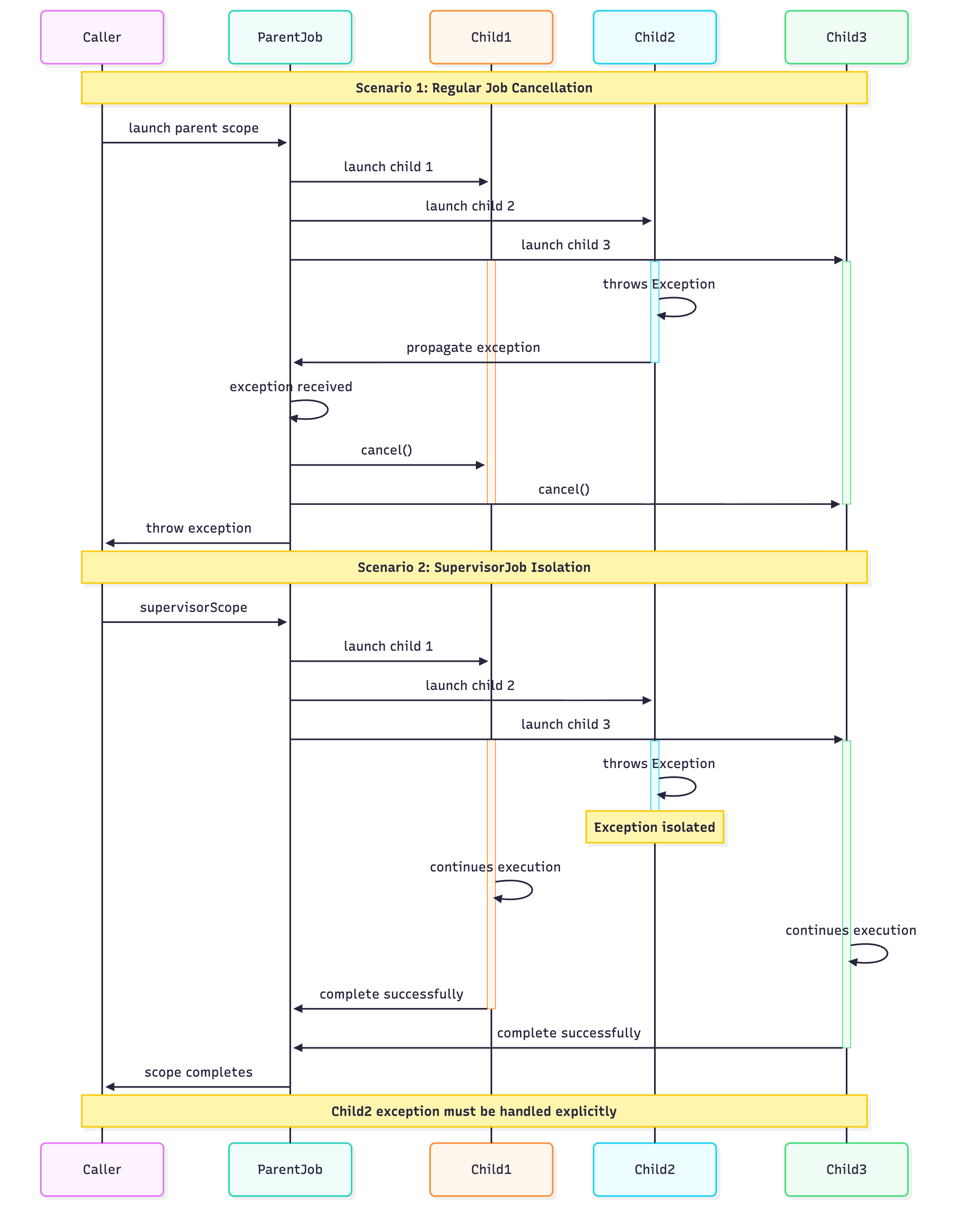
Upward propagation: If a child fails with an exception, it cancels its parent
Downward propagation: If a parent is cancelled, all children are cancelled
Sibling propagation: If one child fails, siblings are cancelled through the parent
fun main() = runBlocking {
    val job = launch {
        val child1 = launch {
            delay(1000)
            println(”Child 1 completed”)
        }

        val child2 = launch {
            delay(500)
            throw RuntimeException(”Child 2 failed!”)
        }

        val child3 = launch {
            delay(2000)
            println(”Child 3 completed”)
        }
    }

    try {
        job.join()
    } catch (e: Exception) {
        println(”Parent caught: ${e.message}”)
    }
    // All children are cancelled when child2 fails
}
What is a SupervisorJob?
A SupervisorJob is a special type of Job that changes the cancellation behavior. With a SupervisorJob:
Child failures don’t propagate upward - a failed child doesn’t cancel the parent
Downward propagation still works - cancelling the parent still cancels children
Siblings are independent - one child’s failure doesn’t affect siblings
SupervisorJob Example
fun main() = runBlocking {
    val supervisor = SupervisorJob()

    with(CoroutineScope(coroutineContext + supervisor)) {
        val child1 = launch {
            delay(1000)
            println(”Child 1 completed”)
        }

        val child2 = launch {
            delay(500)
            throw RuntimeException(”Child 2 failed!”)
        }

        val child3 = launch {
            delay(2000)
            println(”Child 3 completed successfully!”)
        }
    }

    delay(3000)
    println(”All independent children handled”)
}
SupervisorScope
Kotlin provides supervisorScope as a convenient way to create a supervisor context:
suspend fun fetchUserData() = supervisorScope {
    val profile = async {
        delay(1000)
        “Profile Data”
    }

    val posts = async {
        delay(500)
        throw Exception(”Failed to fetch posts”)
    }

    val friends = async {
        delay(1500)
        “Friends Data”
    }

    // Even though posts fails, profile and friends complete
    try {
        println(”Profile: ${profile.await()}”)
    } catch (e: Exception) {
        println(”Profile failed”)
    }

    try {
        println(”Posts: ${posts.await()}”)
    } catch (e: Exception) {
        println(”Posts failed: ${e.message}”)
    }

    try {
        println(”Friends: ${friends.await()}”)
    } catch (e: Exception) {
        println(”Friends failed”)
    }
}
Comparison: Job vs SupervisorJob
Aspect Job SupervisorJob Child failure Cancels parent and siblings Only affects that child Parent cancellation Cancels all children Cancels all children Use case Related tasks that should fail together Independent tasks Exception handling Automatic propagation Must handle per child Typical scenario Database transaction Multiple API calls
Real-World Use Cases
Use Case 1: Data Synchronization (Job)
When syncing data where all operations must succeed or fail together:
suspend fun syncData() = coroutineScope {
    launch {
        syncUsers()     // Must succeed
    }
    launch {
        syncProducts()  // Must succeed
    }
    launch {
        syncOrders()    // Must succeed
    }
    // If any fails, all are cancelled - maintains data consistency
}
Use Case 2: Dashboard Data Loading (SupervisorJob)
Loading multiple independent widgets on a dashboard:
suspend fun loadDashboard() = supervisorScope {
    val weather = async {
        loadWeatherWidget()
    }

    val news = async {
        loadNewsWidget()
    }

    val stocks = async {
        loadStocksWidget()
    }

    // Each widget loads independently
    // If news fails, weather and stocks still display
    listOfNotNull(
        weather.await(),
        news.await().takeIf { /* handle error */ },
        stocks.await()
    )
}
Exception Handling Strategies
With Regular Job
fun main() = runBlocking {
    val handler = CoroutineExceptionHandler { _, exception ->
        println(”Caught: ${exception.message}”)
    }

    val job = launch(handler) {
        launch {
            throw Exception(”Child exception”)
        }
    }

    job.join()
}
With SupervisorJob
fun main() = runBlocking {
    supervisorScope {
        val job1 = launch {
            try {
                throw Exception(”Job 1 failed”)
            } catch (e: Exception) {
                println(”Handled: ${e.message}”)
            }
        }

        val job2 = launch {
            delay(1000)
            println(”Job 2 completed”)
        }

        // Both jobs execute independently
    }
}
Best Practices
1. Use Job for Related Operations
suspend fun processOrder(orderId: String) = coroutineScope {
    launch { validateOrder(orderId) }
    launch { reserveInventory(orderId) }
    launch { processPayment(orderId) }
    // All must succeed or entire operation fails
}
2. Use SupervisorJob for Independent Operations
suspend fun loadUserProfile() = supervisorScope {
    async { loadBasicInfo() }      // Critical
    async { loadRecommendations() } // Optional
    async { loadActivityFeed() }    // Optional
}
3. Always Handle Exceptions in SupervisorScope
supervisorScope {
    val results = listOf(
        async { operation1() },
        async { operation2() },
        async { operation3() }
    ).map { deferred ->
        try {
            deferred.await()
        } catch (e: Exception) {
            null // or default value
        }
    }
}
4. Use Structured Concurrency
// Good: Structured
suspend fun fetchData() = coroutineScope {
    val data1 = async { fetch1() }
    val data2 = async { fetch2() }
    combineData(data1.await(), data2.await())
}

// Avoid: Unstructured
suspend fun fetchDataUnstructured() {
    GlobalScope.launch { // Don’t do this!
        fetch1()
    }
}
Common Pitfalls
Pitfall 1: Not Handling Exceptions in SupervisorScope
// Wrong - exception not handled
supervisorScope {
    launch {
        throw Exception(”This will crash!”)
    }
}

// Correct - exception handled
supervisorScope {
    launch {
        try {
            riskyOperation()
        } catch (e: Exception) {
            handleError(e)
        }
    }
}
Pitfall 2: Using Job When You Need SupervisorJob
// Wrong for independent operations
coroutineScope {
    launch { loadWidget1() } // If this fails...
    launch { loadWidget2() } // ...this gets cancelled too
}

// Correct for independent operations
supervisorScope {
    launch { loadWidget1() } // Fails independently
    launch { loadWidget2() } // Continues running
}
Performance Considerations
Job Overhead
Minimal overhead for simple parent-child relationships
Exception propagation is fast and automatic
Best for tightly coupled operations
SupervisorJob Overhead
Slightly more overhead due to independent exception handling
Requires explicit exception handling per child
Better for loosely coupled operations with different completion times
Advanced Patterns
Pattern 1: Hybrid Approach
suspend fun complexOperation() = supervisorScope {
    // Independent groups
    launch {
        // Group 1: Related operations
        coroutineScope {
            launch { step1a() }
            launch { step1b() }
        }
    }

    launch {
        // Group 2: Related operations
        coroutineScope {
            launch { step2a() }
            launch { step2b() }
        }
    }
}
Pattern 2: Selective Supervision
suspend fun loadContent() = coroutineScope {
    // Critical content - fails together
    val critical = async { loadCriticalData() }

    // Optional content - supervised
    val optional = async(SupervisorJob()) {
        supervisorScope {
            launch { loadAds() }
            launch { loadRecommendations() }
        }
    }

    critical.await() // Must succeed
    optional.await() // Best effort
}
Conclusion
Understanding the difference between Job and SupervisorJob is essential for building resilient Kotlin applications:
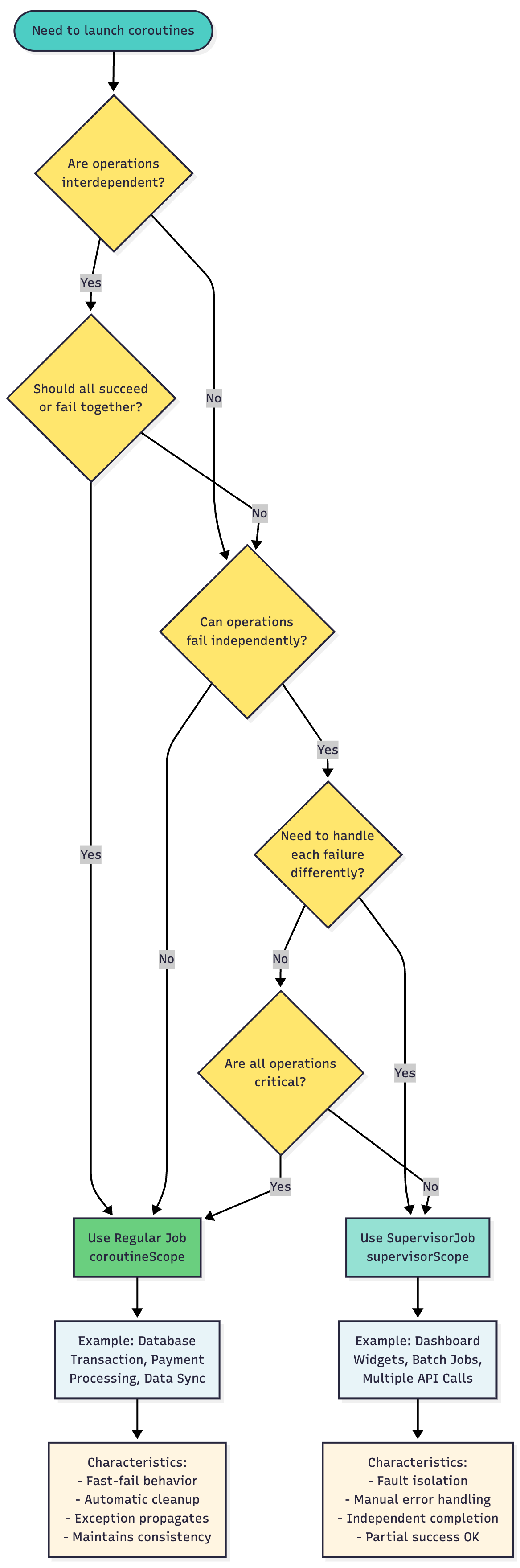
Use Job when operations are interdependent and should succeed or fail together (transactions, critical workflows)
Use SupervisorJob when operations are independent and one failure shouldn’t affect others (UI widgets, optional features)
The key is understanding your application’s failure domain boundaries and choosing the appropriate tool for managing those boundaries. With proper use of these constructs, you can build applications that are both robust and fault-tolerant.