
Deep Dive into withContext: A Complete Technical Guide


Introduction
withContext is one of the most powerful and frequently used coroutine builders in Kotlin. It allows you to switch the coroutine context (typically the dispatcher) for a specific block of code and return a result. This comprehensive guide explores every aspect of withContext, including its internals, edge cases, and best practices.
What is withContext?
withContext is a suspending function that executes a block of code with a modified coroutine context. It suspends the current coroutine, runs the block with the new context, and returns the result.
suspend fun <T> withContext(
    context: CoroutineContext,
    block: suspend CoroutineScope.() -> T
): T
Key Characteristics
Context Switching: Merges the provided context with the current context
Result Return: Returns the result of the block execution
Cancellation Aware: Respects coroutine cancellation
Type Safe: Uses Kotlin contracts for type safety
How withContext Works
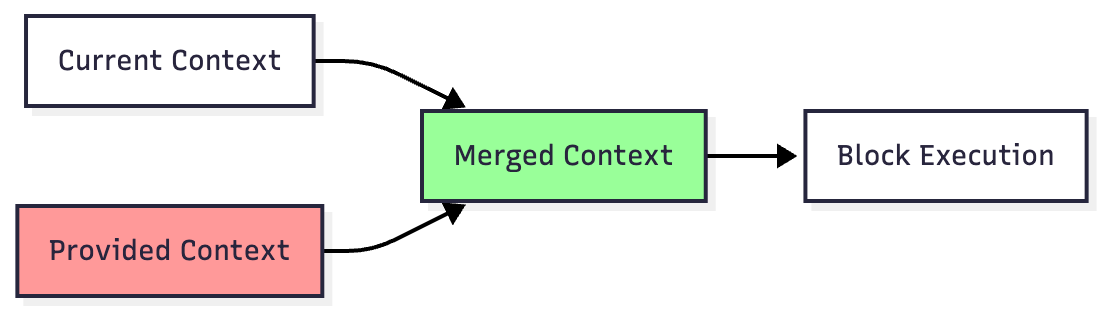
Context Merging
The new context is derived by merging:
val newContext = coroutineContext + context
This follows [CoroutineContext.plus] semantics where the right operand overrides elements from the left.
Execution Flow
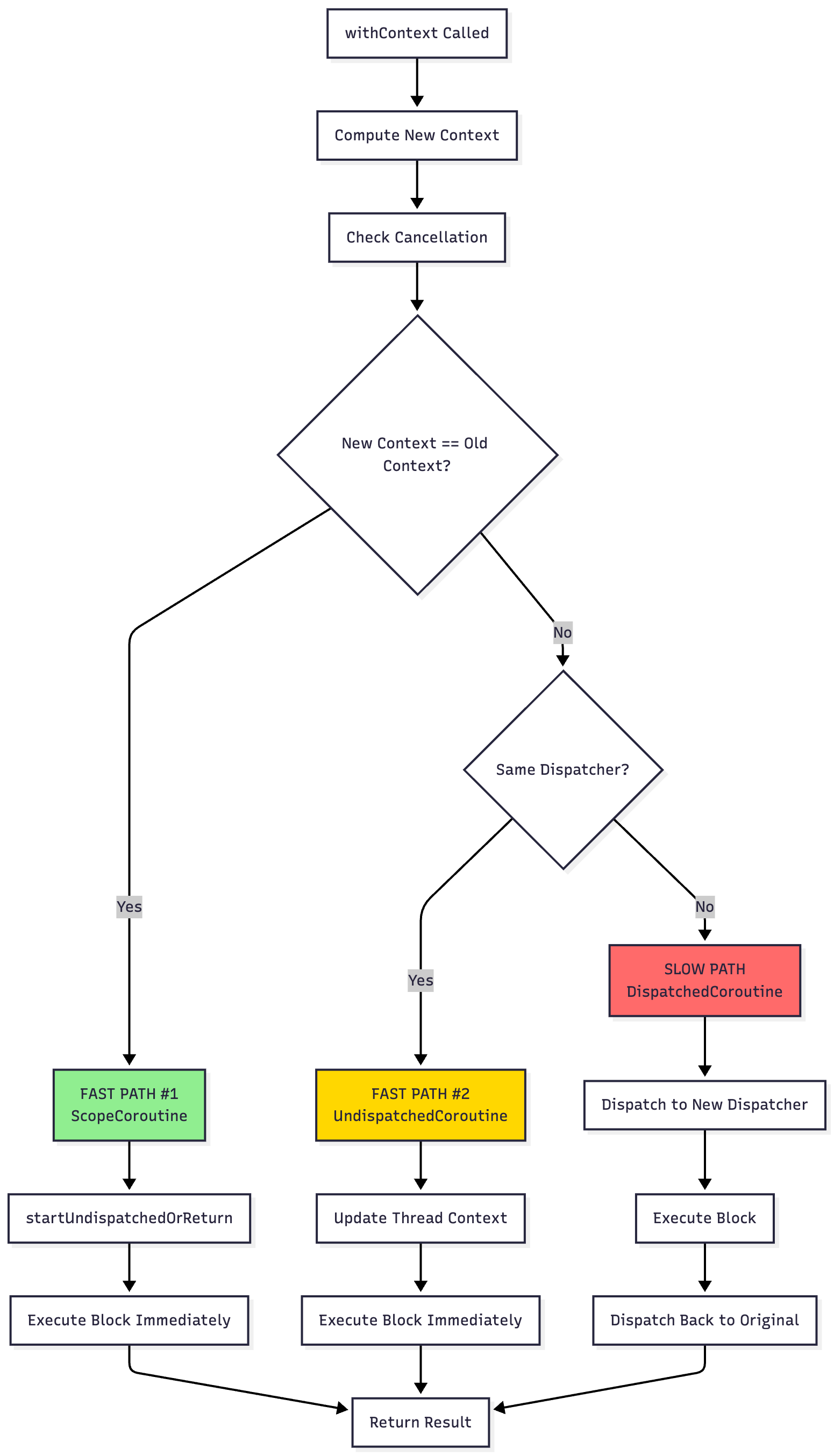
The Three Execution Paths
Fast Path #1: Identical Context
When the new context is exactly the same as the old context (reference equality):
if (newContext === oldContext) {
    val coroutine = ScopeCoroutine(newContext, uCont)
    return coroutine.startUndispatchedOrReturn(coroutine, block)
}
Example:
withContext(EmptyCoroutineContext) {
    // Executes immediately without any context changes
    println(”Same context”)
}
Characteristics:
No dispatcher switch
Executes immediately (undispatched)
Minimal overhead
Used when context addition results in no change
Fast Path #2: Same Dispatcher, Different Context
When only non-dispatcher elements change (Job, CoroutineName, etc.):
if (newContext[ContinuationInterceptor] == oldContext[ContinuationInterceptor]) {
    val coroutine = UndispatchedCoroutine(newContext, uCont)
    withCoroutineContext(coroutine.context, null) {
        return coroutine.startUndispatchedOrReturn(coroutine, block)
    }
}
Example:
withContext(Dispatchers.IO) {
    // Already on IO dispatcher
    withContext(CoroutineName(”MyCoroutine”)) {
        // Same dispatcher, only name changed
        // Executes immediately without re-dispatch
        println(”Fast path #2”)
    }
}
Characteristics:
No dispatcher change
Updates thread-local context elements
Executes immediately
More efficient than slow path
Slow Path: Different Dispatcher
When the dispatcher changes:
val coroutine = DispatchedCoroutine(newContext, uCont)
block.startCoroutineCancellable(coroutine, coroutine)
coroutine.getResult()
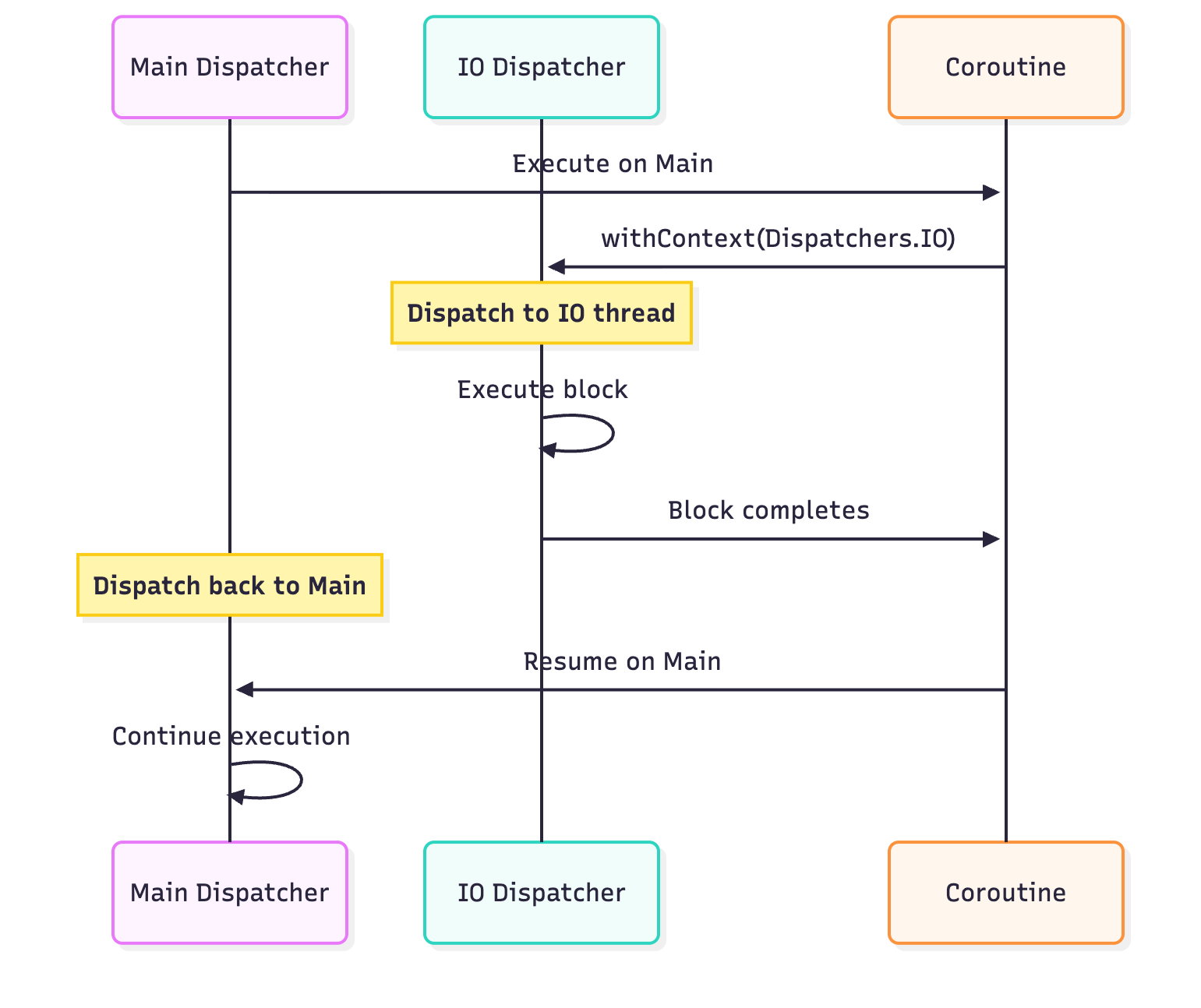
Example:
withContext(Dispatchers.Main) {
    val data = withContext(Dispatchers.IO) {
        // Dispatches to IO thread
        loadData()
        // Dispatches back to Main
    }
    updateUI(data)
}
Characteristics:
Performs actual thread/dispatcher switch
Two dispatches: to new dispatcher and back
Higher overhead
Supports prompt cancellation
Cancellation Behavior
Immediate Cancellation Check
withContext checks cancellation immediately:
newContext.ensureActive()
Example:
val job = launch {
    delay(100)
    cancel() // Cancel the job

    // This will throw CancellationException immediately
    withContext(Dispatchers.IO) {
        println(”This won’t execute”)
    }
}
Prompt Cancellation Guarantee
When dispatcher changes, cancellation is checked when resuming:
launch(Dispatchers.Main) {
    val result = withContext(Dispatchers.IO) {
        delay(1000)
        “Result”
    }
    // If cancelled here, result is discarded
    println(result) // May not execute if cancelled
}

Edge Case: No Dispatcher Change
When dispatcher doesn’t change, prompt cancellation doesn’t apply:
launch {
    withContext(NonCancellable) {
        // This block will complete even if parent is cancelled
        delay(1000)
        println(”Completes despite cancellation”)
    }
}
Important: Only the execution is protected, not the result propagation.
Common Use Cases
1. Thread Switching for I/O Operations
suspend fun loadUserData(): User = withContext(Dispatchers.IO) {
    database.getUser()
}
2. CPU-Intensive Calculations
suspend fun processLargeDataset(data: List<Int>): Result =
    withContext(Dispatchers.Default) {
        data.map { complexCalculation(it) }
            .reduce { acc, value -> acc + value }
    }
3. Main Thread Updates
withContext(Dispatchers.Main) {
    progressBar.visibility = View.VISIBLE
}
4. Combining Multiple Contexts
withContext(Dispatchers.IO + CoroutineName(”DataLoader”)) {
    loadData()
}
5. Timeout with Context Switch
withContext(Dispatchers.IO) {
    withTimeout(5000) {
        slowNetworkCall()
    }
}
Edge Cases and Gotchas
Edge Case 1: Context Element Inheritance
val job = Job()
withContext(job) {
    println(coroutineContext[Job]) // The provided job

    withContext(Dispatchers.IO) {
        // Job is inherited from parent
        println(coroutineContext[Job]) // Still the same job
    }
}
Edge Case 2: NonCancellable Context
launch {
    try {
        withContext(NonCancellable) {
            delay(1000)
            cleanupResources() // Will complete even if cancelled
        }
    } catch (e: CancellationException) {
        // Caught after withContext completes
    }
}
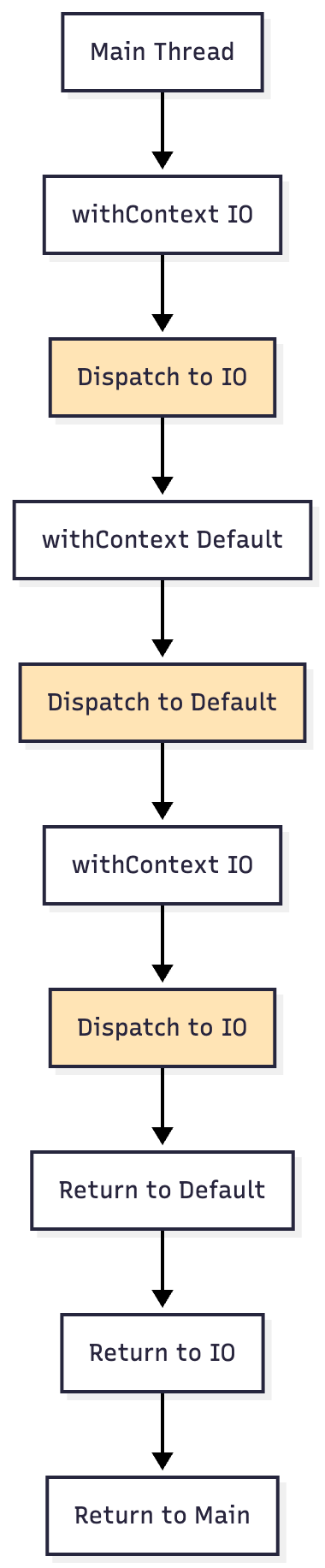
Edge Case 3: Nested withContext
withContext(Dispatchers.IO) {
    // On IO dispatcher

    withContext(Dispatchers.Default) {
        // Switched to Default

        withContext(Dispatchers.IO) {
            // Back to IO - but this is a new dispatch!
        }
    }
}
Edge Case 4: Exception Handling
try {
    withContext(Dispatchers.IO) {
        throw IOException(”Network error”)
    }
} catch (e: IOException) {
    // Exception propagates normally
    handleError(e)
}
Exceptions are propagated to the caller, just like regular suspend functions.
Edge Case 5: Structured Concurrency
coroutineScope {
    val deferred1 = async(Dispatchers.IO) { loadData1() }
    val deferred2 = async(Dispatchers.IO) { loadData2() }

    withContext(Dispatchers.Default) {
        // If this throws, deferred1 and deferred2 are cancelled
        processData(deferred1.await(), deferred2.await())
    }
}
Edge Case 6: CoroutineStart.UNDISPATCHED Interaction
// This doesn’t apply to withContext as it always suspends
// But be aware when combining with other builders
launch(start = CoroutineStart.UNDISPATCHED) {
    withContext(Dispatchers.IO) {
        // Will always dispatch, even with UNDISPATCHED start
    }
}
Edge Case 7: Infinite Recursion Risk
// Dangerous: Can cause stack overflow in fast paths
suspend fun recursive(n: Int): Int = withContext(EmptyCoroutineContext) {
    if (n <= 0) 0
    else n + recursive(n - 1) // No actual suspension point
}
Edge Case 8: Thread-Local Context Elements
val threadLocal = ThreadLocal<String>()

withContext(Dispatchers.IO + threadLocal.asContextElement(”value1”)) {
    println(threadLocal.get()) // “value1”

    withContext(Dispatchers.Default) {
        // Thread changed, but element copied
        println(threadLocal.get()) // “value1”
    }
}
Performance Considerations
Overhead Comparison

Best Practices for Performance
Minimize Context Switches: Batch operations on same dispatcher
// Bad: Multiple switches
suspend fun loadAllData() {
    val user = withContext(Dispatchers.IO) { loadUser() }
    val posts = withContext(Dispatchers.IO) { loadPosts() }
    val comments = withContext(Dispatchers.IO) { loadComments() }
}

// Good: Single switch
suspend fun loadAllData() = withContext(Dispatchers.IO) {
    val user = loadUser()
    val posts = loadPosts()
    val comments = loadComments()
    Triple(user, posts, comments)
}
Avoid Unnecessary Context Changes
// Already on IO dispatcher
withContext(Dispatchers.IO) {
    // Unnecessary: No-op due to fast path #1
    withContext(Dispatchers.IO) {
        readFile()
    }
}
Use Appropriate Dispatchers
// CPU-bound work
withContext(Dispatchers.Default) {
    complexCalculation()
}

// I/O-bound work
withContext(Dispatchers.IO) {
    networkCall()
}

// UI updates
withContext(Dispatchers.Main) {
    updateViews()
}
Comparison with Other Builders
withContext vs async/await
// Using withContext
val result = withContext(Dispatchers.IO) {
    loadData()
}

// Using async/await
val result = async(Dispatchers.IO) {
    loadData()
}.await()
Differences:
withContextis sequential and blockingasynccreates a new coroutine that can run concurrentlywithContexthas less overhead for sequential operations
withContext vs launch
// withContext: Returns result
val data = withContext(Dispatchers.IO) {
    loadData()
}

// launch: Fire and forget
launch(Dispatchers.IO) {
    loadData() // Can’t return result directly
}

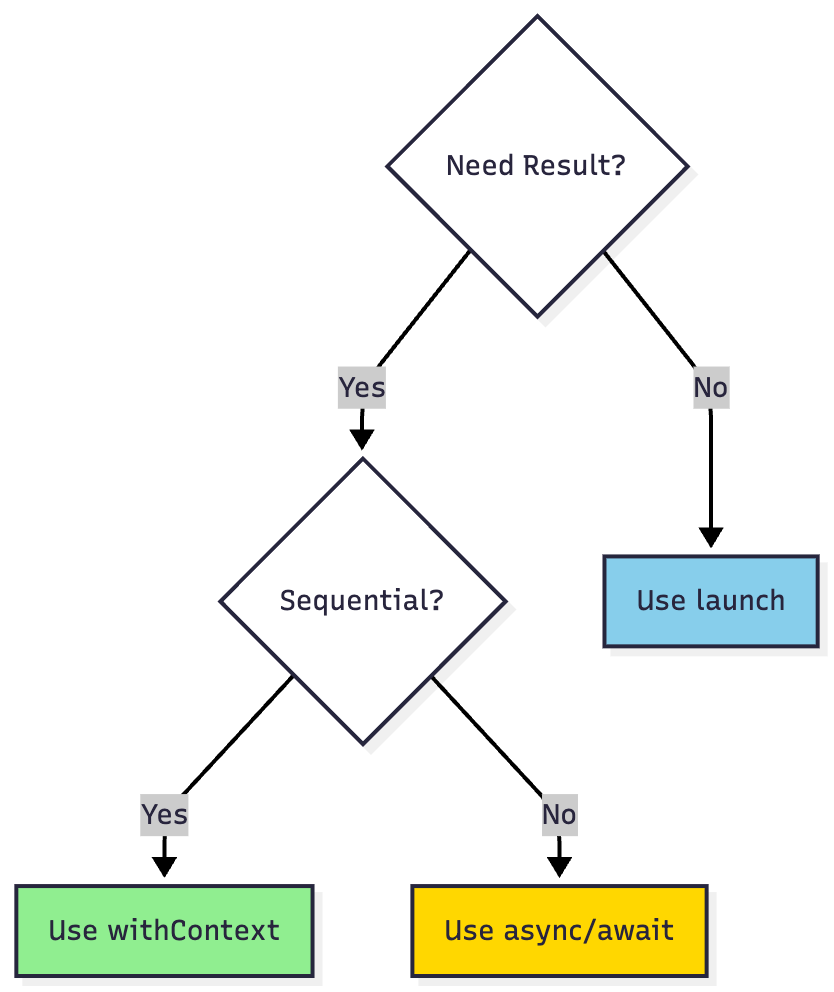
Decision Matrix
Advanced Patterns
Pattern 1: Fallback Dispatcher
suspend fun <T> withContextOrDefault(
    context: CoroutineContext?,
    default: CoroutineContext = Dispatchers.Default,
    block: suspend CoroutineScope.() -> T
): T = withContext(context ?: default, block)
Pattern 2: Retrying with Different Dispatcher
suspend fun <T> withRetry(
    dispatchers: List<CoroutineDispatcher>,
    block: suspend () -> T
): T {
    var lastException: Exception? = null

    for (dispatcher in dispatchers) {
        try {
            return withContext(dispatcher) { block() }
        } catch (e: Exception) {
            lastException = e
        }
    }

    throw lastException!!
}
Pattern 3: Conditional Context Switch
suspend fun <T> withContextIf(
    condition: Boolean,
    context: CoroutineContext,
    block: suspend CoroutineScope.() -> T
): T = if (condition) {
    withContext(context, block)
} else {
    coroutineScope(block)
}
Pattern 4: Context Timing
suspend fun <T> withContextTimed(
    context: CoroutineContext,
    block: suspend CoroutineScope.() -> T
): Pair<T, Long> {
    val start = System.currentTimeMillis()
    val result = withContext(context, block)
    val duration = System.currentTimeMillis() - start
    return result to duration
}
Testing withContext
Test Example with TestDispatchers
@Test
fun testWithContext() = runTest {
    val result = withContext(StandardTestDispatcher()) {
        delay(1000)
        “Done”
    }

    assertEquals(”Done”, result)
}
Mocking Context Switches
class TestRepository(
    private val dispatcher: CoroutineDispatcher = Dispatchers.IO
) {
    suspend fun loadData() = withContext(dispatcher) {
        // Load data
    }
}

@Test
fun testLoadData() = runTest {
    val repository = TestRepository(StandardTestDispatcher(testScheduler))
    val result = repository.loadData()
    // Test assertions
}
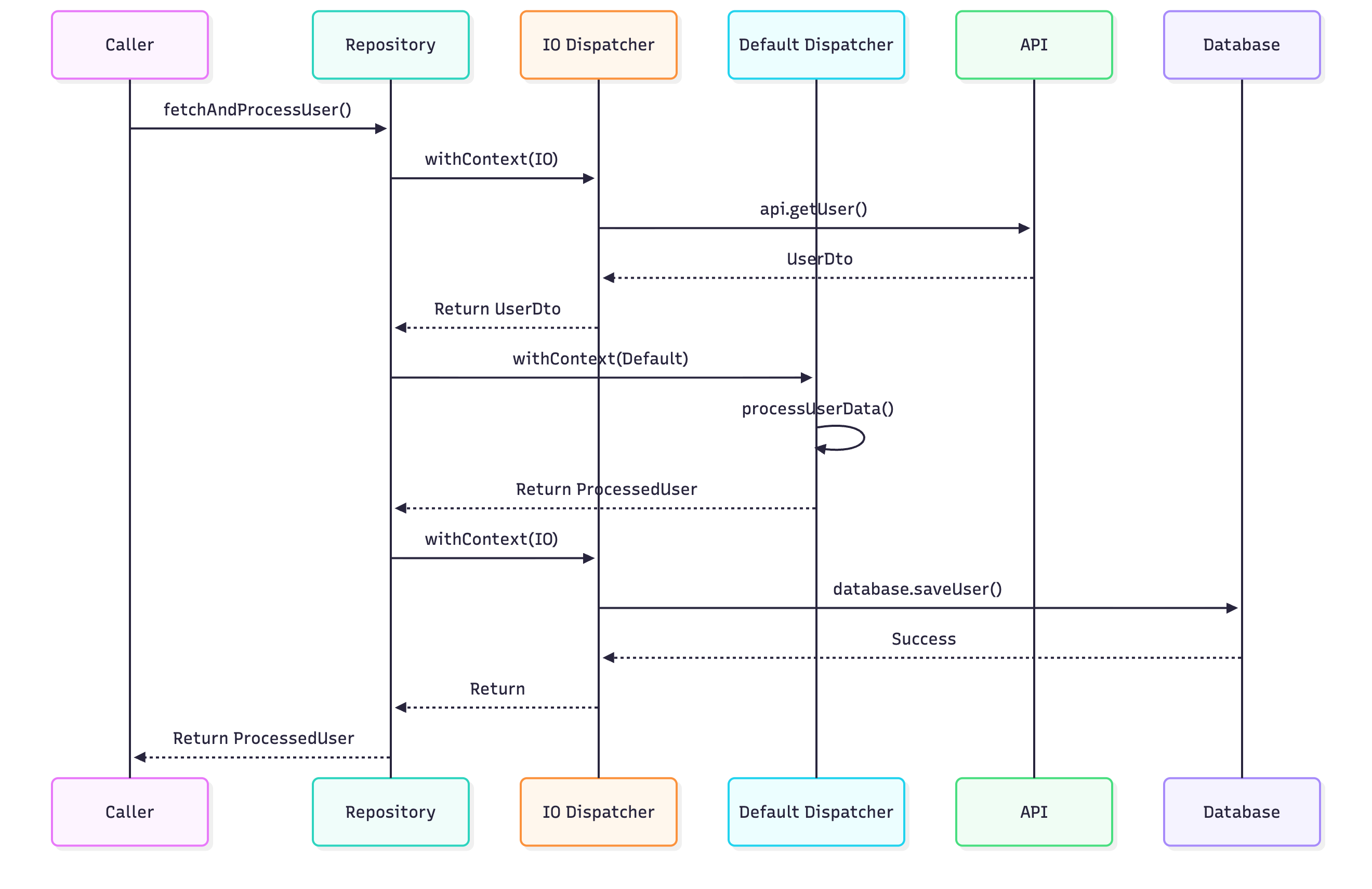
Complete Example: Real-World Scenario
class UserRepository(
    private val api: UserApi,
    private val database: UserDatabase,
    private val ioDispatcher: CoroutineDispatcher = Dispatchers.IO,
    private val defaultDispatcher: CoroutineDispatcher = Dispatchers.Default
) {
    suspend fun fetchAndProcessUser(userId: String): ProcessedUser {
        // Fetch from network on IO dispatcher
        val userDto = withContext(ioDispatcher) {
            api.getUser(userId)
        }

        // Process data on Default dispatcher (CPU-intensive)
        val processedUser = withContext(defaultDispatcher) {
            processUserData(userDto)
        }

        // Save to database on IO dispatcher
        withContext(ioDispatcher) {
            database.saveUser(processedUser)
        }

        return processedUser
    }

    private fun processUserData(dto: UserDto): ProcessedUser {
        // Complex calculation
        return ProcessedUser(
            id = dto.id,
            name = dto.name.uppercase(),
            score = calculateScore(dto)
        )
    }

    private fun calculateScore(dto: UserDto): Int {
        // CPU-intensive operation
        return dto.activities.sumOf { it.points * it.multiplier }
    }
}
Summary
Key Takeaways
Context Merging:
withContextmerges provided context with current contextThree Paths: Fast path #1 (identical), fast path #2 (same dispatcher), slow path (different dispatcher)
Cancellation: Immediate check on entry, prompt cancellation on dispatcher change
Performance: Minimize context switches for better performance
Type Safety: Returns typed result and respects structured concurrency
When to Use withContext
✅ Use when:
Switching dispatchers for specific operations
Need to return a result
Sequential execution is required
Want to temporarily change context elements
❌ Don’t use when:
Need concurrent execution (use
asyncinstead)Fire-and-forget operation (use
launchinstead)Already on the correct dispatcher (unnecessary overhead)
Common Pitfalls
Excessive context switching: Batch operations on same dispatcher
Ignoring cancellation: Always respect cancellation in long-running operations
Wrong dispatcher choice: Use IO for I/O, Default for CPU work
Nested switches: Avoid unnecessary nesting that causes multiple dispatches