
Deep Dive into derivedStateOf in Jetpack Compose


Introduction
In Jetpack Compose, state management is fundamental to building reactive UIs. While mutableStateOf allows you to create observable state, derivedStateOf provides a powerful mechanism to create computed state that automatically updates when its dependencies change. This article explores the internal architecture and implementation details of derivedStateOf.
What is derivedStateOf?
derivedStateOf creates a State object whose value is calculated from other state objects. The key benefits include:
Automatic dependency tracking: Automatically tracks which states are read during calculation
Intelligent caching: Recalculates only when dependencies change
Composition optimization: Prevents unnecessary recompositions
Snapshot integration: Fully integrated with Compose’s snapshot system
Basic Usage
@Composable
fun FilteredList(items: List<String>, searchQuery: String) {
    // Derived state that depends on items and searchQuery
    val filteredItems by remember {
        derivedStateOf {
            items.filter { it.contains(searchQuery, ignoreCase = true) }
        }
    }

    LazyColumn {
        items(filteredItems) { item ->
            Text(item)
        }
    }
}
Architecture Overview
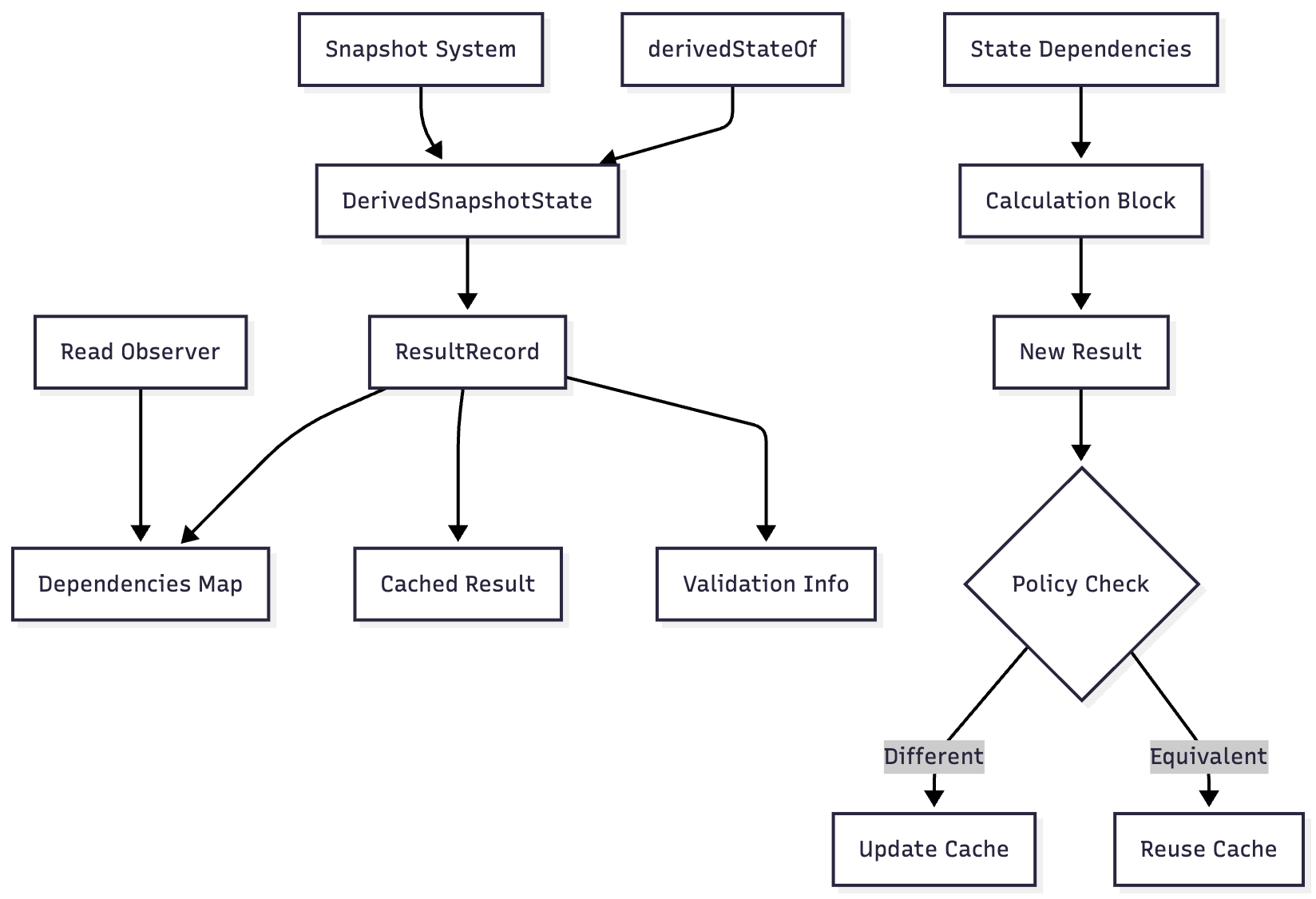
Core Components
1. DerivedSnapshotState
The main implementation class that extends StateObjectImpl and implements DerivedState<T>:
private class DerivedSnapshotState<T>(
    private val calculation: () -> T,
    override val policy: SnapshotMutationPolicy<T>?
) : StateObjectImpl(), DerivedState<T>
Key responsibilities:
Stores the calculation lambda
Manages the record chain (snapshot history)
Coordinates recalculation and caching
Integrates with snapshot observers
2. ResultRecord
Each snapshot has its own ResultRecord that stores:
class ResultRecord<T> : StateRecord, DerivedState.Record<T> {
    var validSnapshotId: SnapshotId
    var validSnapshotWriteCount: Int
    var dependencies: ObjectIntMap<StateObject>
    var result: Any?
    var resultHash: Int
}
Record fields explained:
dependencies: Map of state objects read during calculation → nesting levelresult: Cached calculation resultresultHash: Hash of dependency snapshots for quick validationvalidSnapshotId: Last validated snapshot ID
Dependency Tracking Mechanism
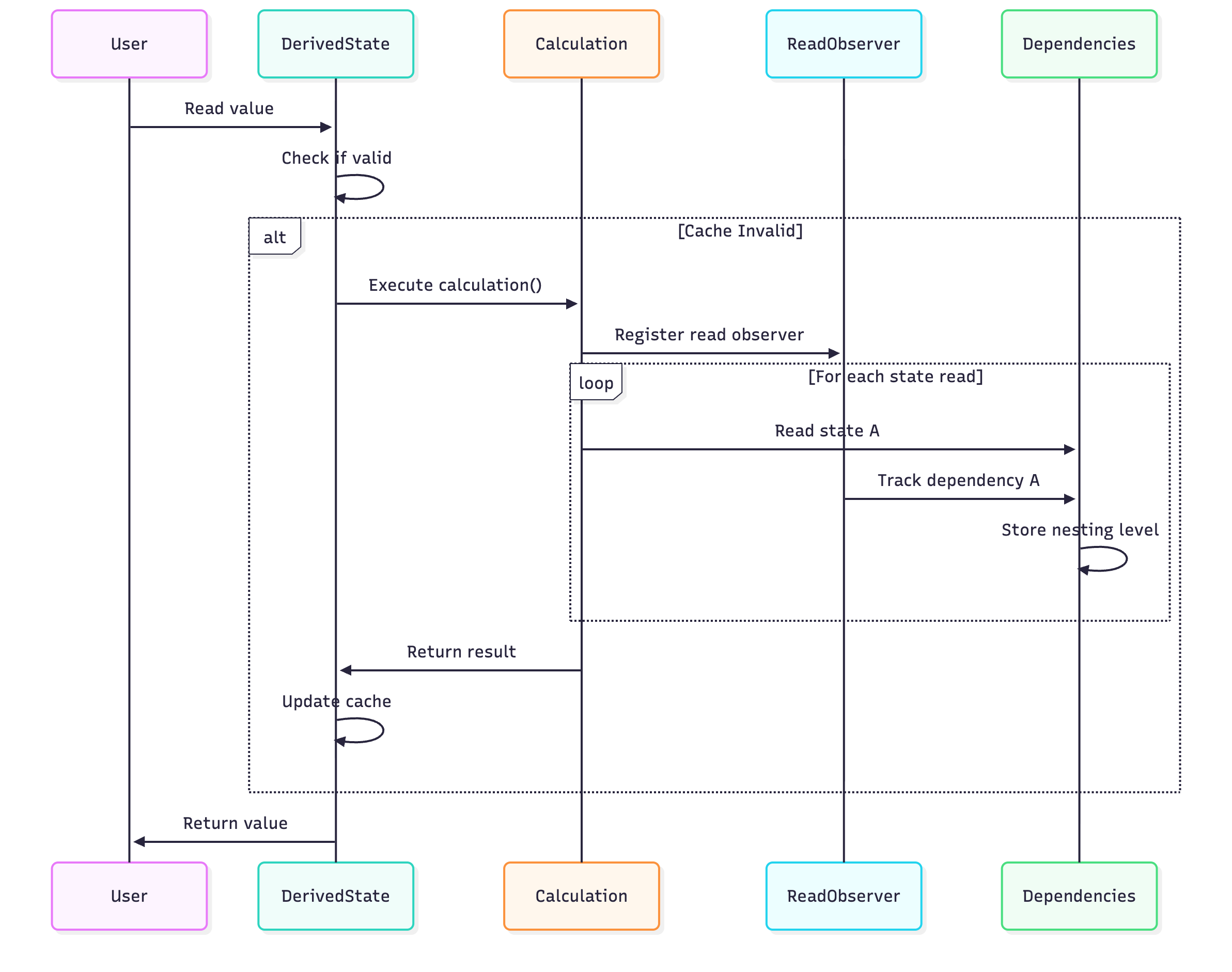
Nested Read Levels
The implementation tracks nesting levels to understand dependency depth:
private val calculationBlockNestedLevel = SnapshotThreadLocal<IntRef>()Example scenario:
val stateA = mutableStateOf(1)
val stateB = derivedStateOf { stateA.value * 2 }  // Level 1 dependency on stateA
val stateC = derivedStateOf { stateB.value + 1 }   // Level 2 dependency on stateA
The nesting level helps determine:
How deep in the calculation chain a dependency is
Which dependencies are direct vs. transitive
Optimal invalidation strategies
Cache Validation Strategy
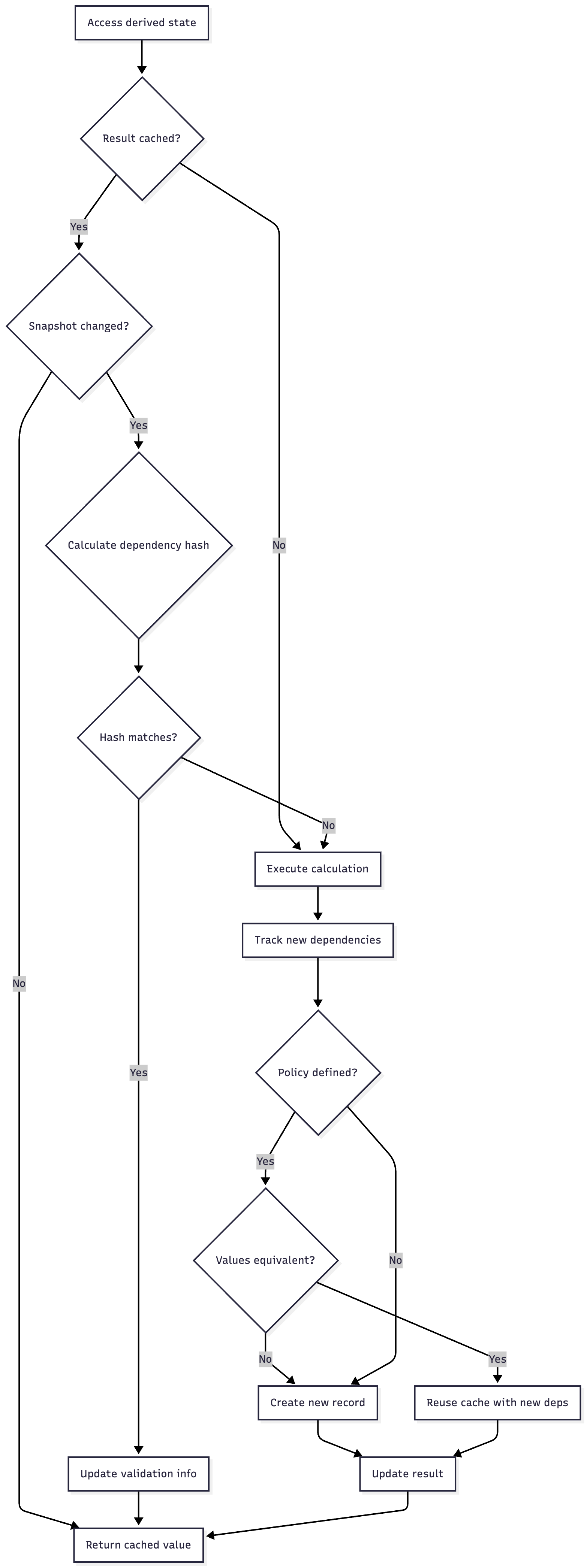
Validation Process
The isValid() method implements a two-tier validation:
Quick check: Compare snapshot ID and write count
Deep check: Calculate hash of all dependency records
fun isValid(derivedState: DerivedState<*>, snapshot: Snapshot): Boolean {
    val snapshotChanged = sync {
        validSnapshotId != snapshot.snapshotId ||
        validSnapshotWriteCount != snapshot.writeCount
    }

    val isValid = result !== Unset &&
        (!snapshotChanged || resultHash == readableHash(derivedState, snapshot))

    return isValid
}
Mutation Policy Integration
The SnapshotMutationPolicy controls when updates trigger recalculation:

Common Policies
// Without policy - updates on any dependency change
val derived1 = derivedStateOf {
    expensiveCalculation()
}

// With structural equality policy
val derived2 = derivedStateOf(
    policy = structuralEqualityPolicy()
) {
    expensiveCalculation()
}

// With referential equality policy
val derived3 = derivedStateOf(
    policy = referentialEqualityPolicy()
) {
    expensiveCalculation()
}
Recalculation Flow
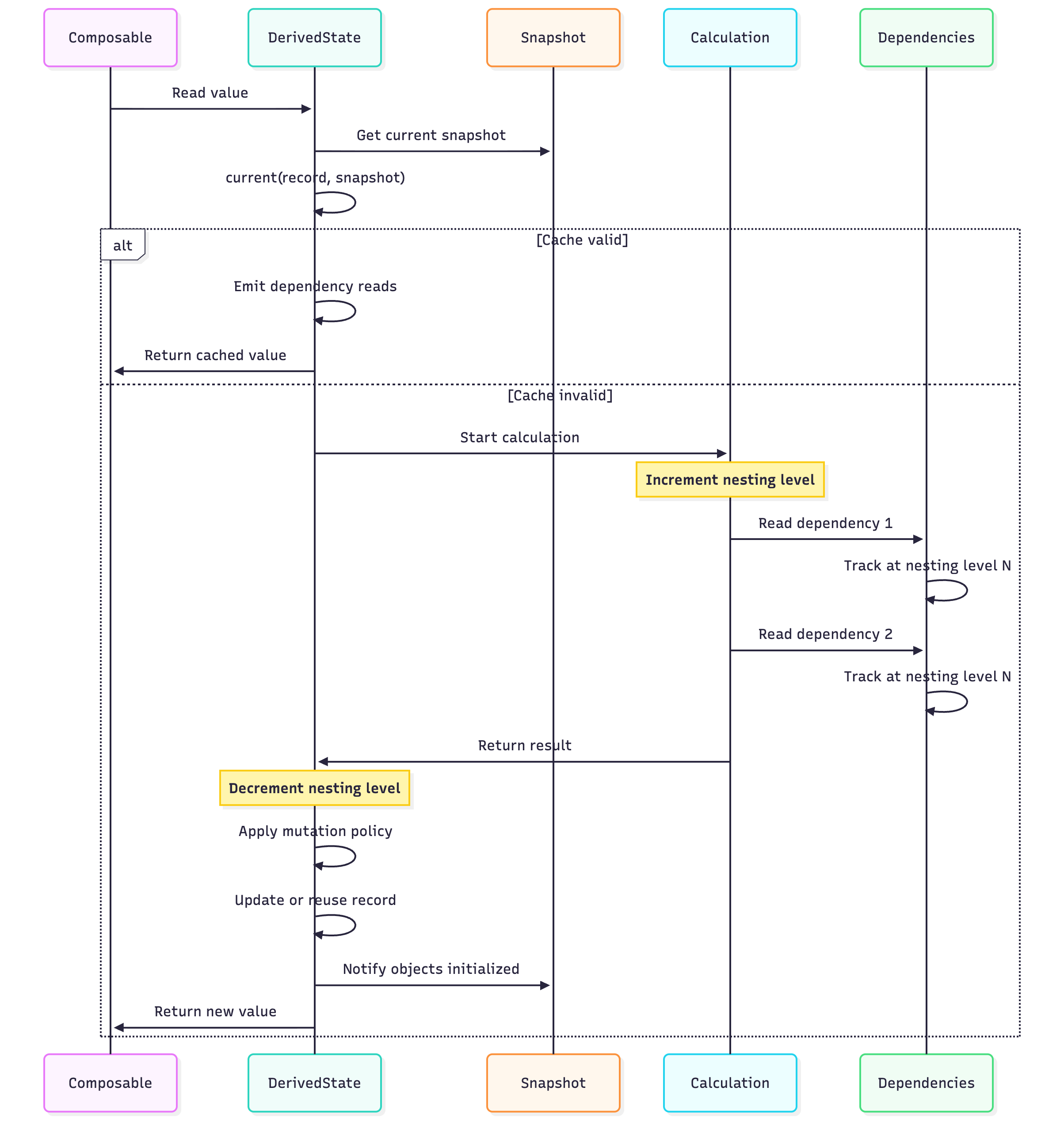
Thread Safety and Synchronization
The implementation uses sync blocks for thread-safe operations:
val record = sync {
    val currentSnapshot = Snapshot.current

    if (readable.result !== ResultRecord.Unset &&
        policy?.equivalent(result, readable.result as T) == true) {
        // Reuse existing record
        readable.dependencies = newDependencies
        readable.resultHash = readable.readableHash(this, currentSnapshot)
        readable
    } else {
        // Create new writable record
        val writable = first.newWritableRecord(this, currentSnapshot)
        writable.dependencies = newDependencies
        writable.resultHash = writable.readableHash(this, currentSnapshot)
        writable.result = result
        writable
    }
}Performance Optimizations
1. Hash-Based Validation
Instead of recalculating on every snapshot change, the system computes a hash of dependency records:
fun readableHash(derivedState: DerivedState<*>, snapshot: Snapshot): Int {
    var hash = 7
    val dependencies = sync { dependencies }

    if (dependencies.isNotEmpty()) {
        dependencies.forEach { stateObject, readLevel ->
            if (readLevel != 1) return@forEach

            val record = current(stateObject.firstStateRecord, snapshot)
            hash = 31 * hash + identityHashCode(record)
            hash = 31 * hash + record.snapshotId.hashCode()
        }
    }
    return hash
}
2. Lazy Recalculation
Recalculation only happens when:
The value is actually read
Dependencies have changed
Cache is invalid for the current snapshot
3. Nested Derived State Optimization
For derived states that depend on other derived states:
val record = if (stateObject is DerivedSnapshotState<*>) {
    // Eagerly access parent derived states
    stateObject.current(snapshot)
} else {
    current(stateObject.firstStateRecord, snapshot)
}
Observer Pattern
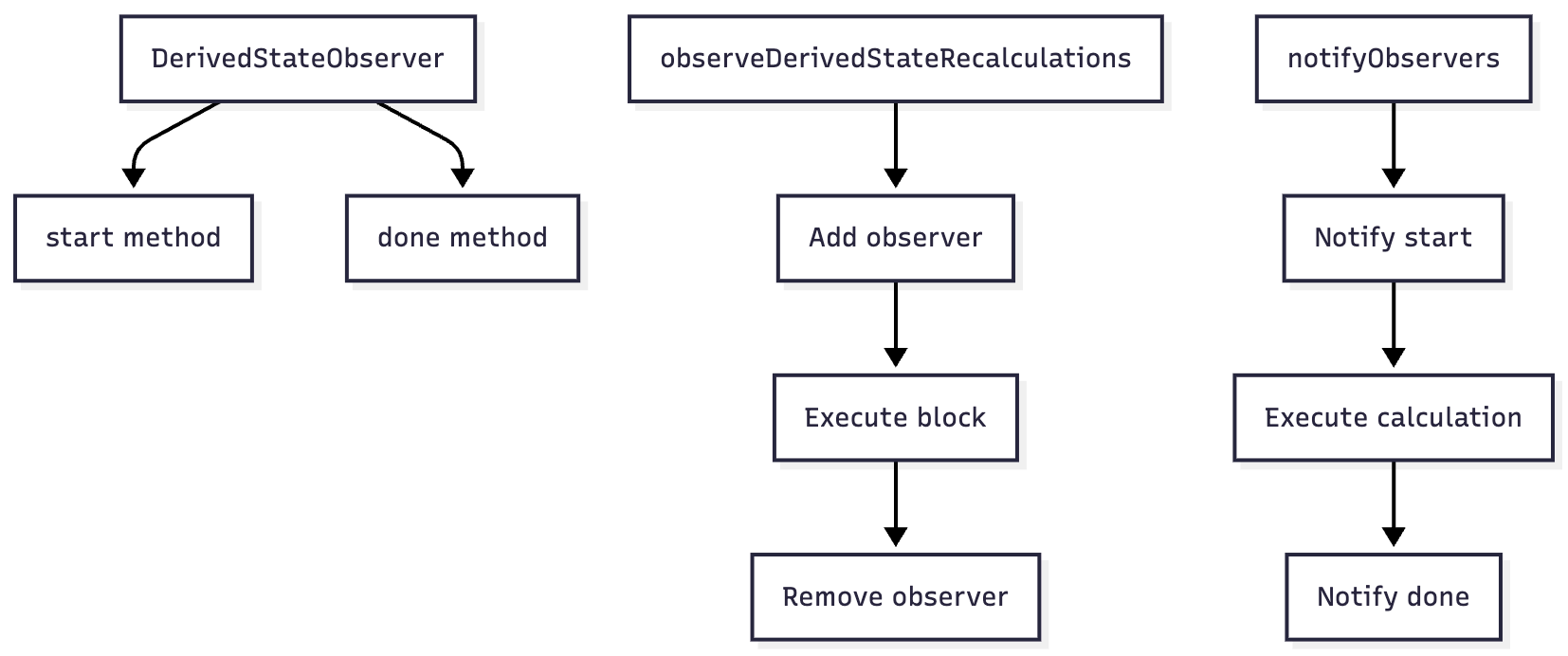
The observer system allows monitoring derived state recalculations:
internal interface DerivedStateObserver {
    fun start(derivedState: DerivedState<*>)
    fun done(derivedState: DerivedState<*>)
}Common Patterns and Best Practices
Pattern 1: Filtering Lists
@Composable
fun SearchableList(items: List<Item>, query: String) {
    val filteredItems by remember {
        derivedStateOf {
            if (query.isEmpty()) items
            else items.filter { it.matches(query) }
        }
    }
}
Pattern 2: Complex Calculations
@Composable
fun Dashboard(transactions: List<Transaction>) {
    val summary by remember {
        derivedStateOf {
            Summary(
                total = transactions.sumOf { it.amount },
                average = transactions.map { it.amount }.average(),
                count = transactions.size
            )
        }
    }
}
Pattern 3: With Mutation Policy
val expensiveComputation by remember {
    derivedStateOf(structuralEqualityPolicy()) {
        // Only recalculate if result structure changes
        computeExpensiveValue(dependency1.value, dependency2.value)
    }
}
When to Use derivedStateOf vs remember
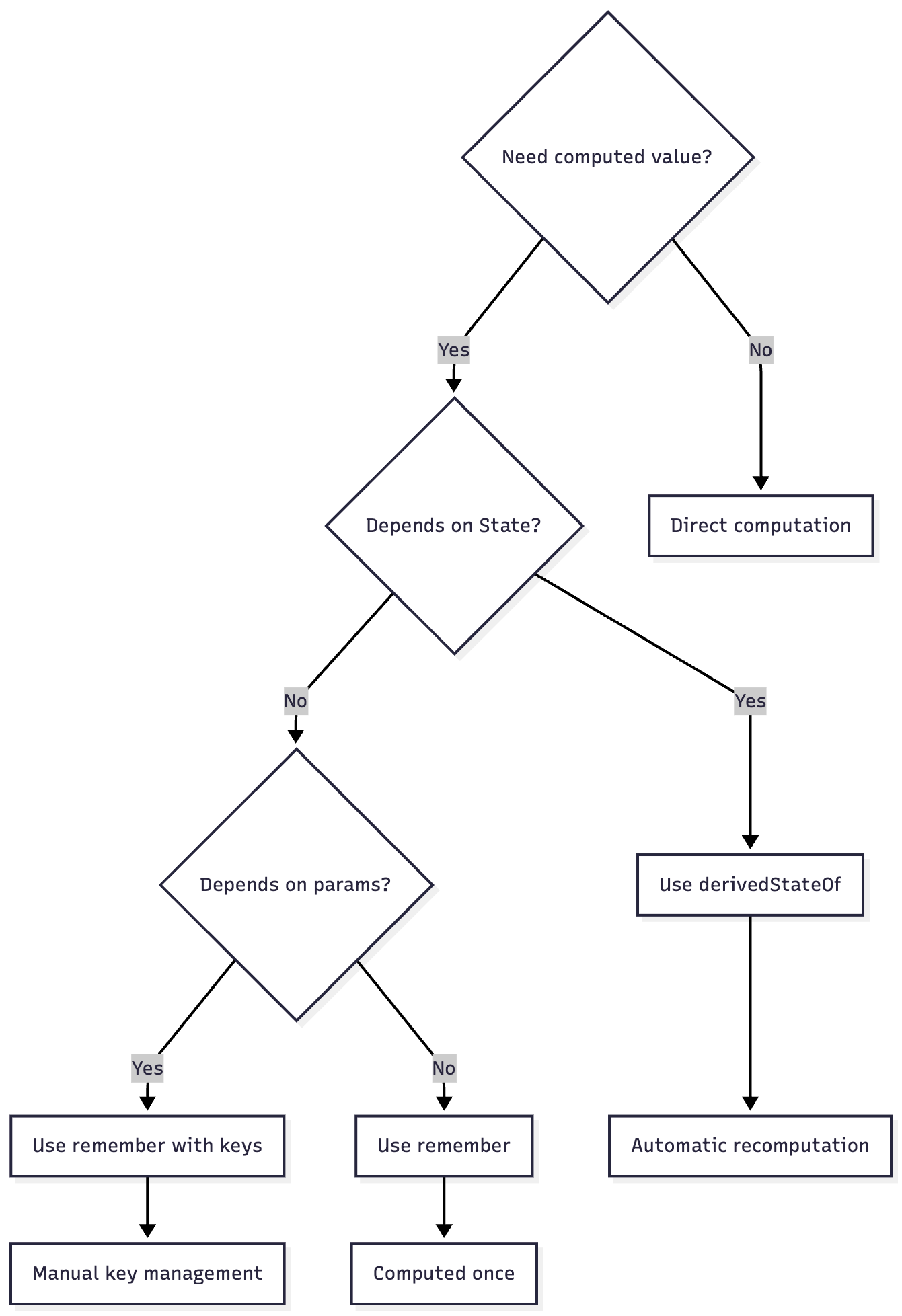
Use derivedStateOf when:
Value depends on
StateobjectsNeed automatic dependency tracking
Want optimal recomposition behavior
Use remember when:
Value depends only on parameters
One-time calculation is sufficient
Manual control over recalculation is needed
Potential Pitfalls
1. Self-Reference
// ❌ ERROR: Will throw exception
val state = derivedStateOf {
    state.value + 1  // Cannot read itself
}
2. Expensive Calculations Without Policy
// ⚠️ May recalculate unnecessarily
val result = derivedStateOf {
    expensiveOperation()  // Recalculates on any dependency change
}

// ✅ Better with policy
val result = derivedStateOf(structuralEqualityPolicy()) {
    expensiveOperation()  // Only updates if result changes
}
3. Missing remember in Composables
// ❌ Creates new derived state on every recomposition
@Composable
fun MyComposable(items: List<String>) {
    val filtered = derivedStateOf { items.filter { it.isNotEmpty() } }
}

// ✅ Correct usage
@Composable
fun MyComposable(items: List<String>) {
    val filtered by remember { derivedStateOf { items.filter { it.isNotEmpty() } } }
}Conclusion
derivedStateOf is a sophisticated mechanism that combines snapshot system integration, intelligent caching, automatic dependency tracking, and flexible mutation policies. Understanding its internals helps developers:
Write more efficient Compose code
Debug state-related issues effectively
Make informed decisions about state management strategies
Optimize recomposition behavior
The implementation demonstrates advanced concepts like nested dependency tracking, hash-based validation, and policy-driven updates, making it a cornerstone of reactive state management in Jetpack Compose.