
Announcing ADK for Kotlin & ADK for Android 0.1.0 — Building AI Agents on Android and Beyond 🚀
Google introduces Agent Development Kit (ADK) for Kotlin and Android, bringing powerful agentic AI workflows to mobile, backend, and edge computing.

AI on Android is entering a completely new era.
At Google I/O 2026, Google officially announced ADK for Kotlin and ADK for Android 0.1.0, extending the Agent Development Kit ecosystem beyond Python, Java, and Go.
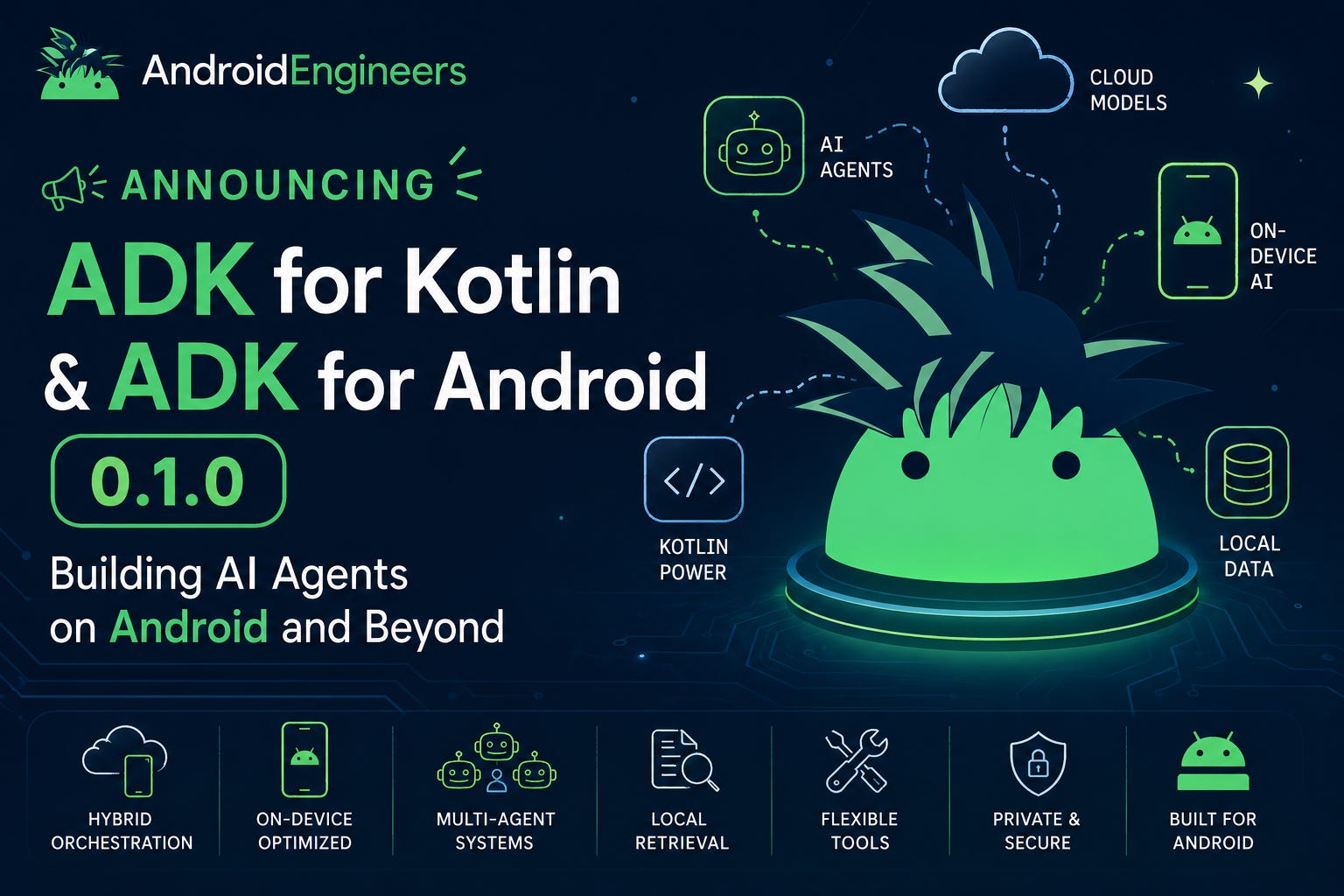
This release enables developers to build intelligent multi-agent AI systems directly in Kotlin while also unlocking on-device AI agents powered by Gemini Nano on Android.
And honestly?
This feels like one of the most important announcements for Android AI development since Gemini Nano arrived on-device.
Why This Matters
The AI ecosystem is rapidly shifting toward edge computing.
With Gemini Nano already available across more than 140 million Android devices, developers are now thinking beyond cloud-only AI architectures.
The new reality is:
Some AI tasks belong in the cloud
Some AI tasks should stay on-device
Privacy matters more than ever
Latency and offline support are becoming critical
AI agents need orchestration, memory, tooling, and delegation
That’s exactly where ADK comes in.
ADK (Agent Development Kit) is Google’s open-source framework for building and orchestrating AI agents.
Now with Kotlin and Android support, developers can create:
✅ Cloud agents
✅ On-device agents
✅ Hybrid AI systems
✅ Multi-agent architectures
✅ Retrieval pipelines
✅ AI workflows in pure Kotlin
What Exactly Is ADK?
ADK is a code-first AI agent framework.
Instead of manually wiring prompts, tools, memory, routing, and orchestration logic together, ADK provides structured primitives for building sophisticated AI systems.
Think of it as:
“Jetpack Compose for AI Agents.”
You define:
Agents
Instructions
Tools
Sub-agents
Memory
Execution flow
And ADK handles:
Orchestration
Context passing
Agent delegation
Tool execution
State management
Error handling
ADK for Kotlin vs ADK for Android
Google launched two separate but complementary libraries.
ADK for Kotlin
Focused on:
Backend systems
JVM apps
Cloud-based orchestration
Kotlin server development
Dependency:
implementation("com.google.adk:google-adk-kotlin-core:0.1.0")
ADK for Android
Focused on:
On-device AI agents
Gemini Nano
Mobile AI orchestration
Privacy-first AI experiences
Dependency:
implementation("com.google.adk:google-adk-kotlin-core-android:0.1.0")
This version includes integrations with:
ML Kit GenAI
Gemini Nano via AI Core
Firebase AI Logic
Cloud Gemini models
The Big Shift: Hybrid AI Architectures
One of the most exciting concepts introduced is Hybrid Orchestration.
Instead of forcing all AI processing into the cloud, ADK allows developers to distribute intelligence across:
☁️ Cloud Models
📱 On-device Models
🔄 Sub-agents
🧠 Retrieval Pipelines
The orchestrator agent can delegate tasks dynamically.
Example:
Cloud model handles reasoning
On-device agent processes private files
Retrieval agent searches local documents
Validation agent verifies results
All coordinated automatically.
This architecture solves major problems:
Privacy
Cost
Latency
Offline support
Context switching
Real-World Example: AI Travel Assistant ✈️
During Google I/O, Google demonstrated a travel assistant built using ADK for Kotlin.
Here’s how it worked.
Step 1 — Cloud Orchestrator Handles Conversation
The main cloud-based agent communicates with the user.
Example:
“I can’t find my hotel reservation.”
The orchestrator understands the request and plans the workflow.
Step 2 — On-Device Agent Accesses Local Documents
Instead of uploading sensitive files to the cloud:
📄 Booking confirmations
📧 Emails
🧾 PDFs
are processed directly on-device using Gemini Nano.
This keeps user data private.
Step 3 — Retrieval Agents Parse Information
Specialized sub-agents:
Extract hotel data
Parse travel documents
Validate reservations
Cross-reference itinerary details
Step 4 — Validation Agent Confirms Results
A final agent verifies consistency between:
Cloud reasoning
Local retrieval
Extracted documents
The result is:
Secure
Fast
Intelligent
Privacy-preserving AI
This is exactly the type of architecture Android developers have been waiting for.
Feature Highlights
ADK for Kotlin & Android ships with an impressive foundational feature set.
1. Hybrid Orchestration
Use cloud models as orchestrators while delegating tasks to on-device sub-agents.
Perfect for:
Secure apps
Enterprise AI
Offline workflows
Privacy-sensitive features
2. Sequential On-Device Agents
Run multi-step workflows entirely on-device.
Example:
Read PDF
Extract text
Summarize content
Generate action items
Without sending anything to the cloud.
3. Local Retrieval Pipelines
Build Retrieval-Augmented Generation (RAG) systems directly on Android.
Use Gemini Nano to:
Parse local documents
Search notes
Analyze files
Process images
All locally.
4. Flexible Tooling System
Agents can use:
Function tools
MCP tools
Long-running tools
Plugins
A2A integrations
This makes ADK extremely extensible.
5. Multi-Agent Systems
ADK allows hierarchical agent design.
You can create:
Root orchestrators
Specialist agents
Validator agents
Retrieval agents
Workflow pipelines
This mirrors how advanced enterprise AI systems are built.
Building Your First AI Agent in Kotlin
Let’s walk through a simple example.
Step 1 — Add Dependencies
dependencies {
    implementation("com.google.adk:google-adk-kotlin-core:0.1.0")
    ksp("com.google.adk:google-adk-kotlin-processor:0.1.0")
}
Step 2 — Create a Tool
ADK tools allow agents to interact with external systems or custom logic.
Example:
class ImprobabilityDriveService {

 @Tool
 fun calculateImprobability(
   @Param("Event to analyze")
   event: String
 ): String {

   return "The improbability of '$event' is approximately 42 to 1 against."
 }
}
Notice the annotations:
@Tool@Param
These describe capabilities to the LLM.
Step 3 — Create a Specialized Agent
val heartOfGoldAgent =
    LlmAgent(
      name = "HeartOfGold",
      description = "Handles improbability queries",
      model = Gemini(
          apiKey = apiKey,
          name = "gemini-2.5-flash"
      ),
      instruction = Instruction(
          "You are cheerful and slightly annoying."
      ),
      tools = ImprobabilityDriveService().generatedTools()
    )
Step 4 — Create a Root Orchestrator
val rootAgent =
  LlmAgent(
    name = "MissionControl",
    subAgents = listOf(heartOfGoldAgent),
    model = Gemini(
        apiKey = apiKey,
        name = "gemini-2.5-flash"
    ),
    instruction = Instruction(
        "Route queries to the appropriate agent."
    )
  )
Now the orchestrator can delegate tasks automatically.
This is where ADK becomes incredibly powerful.
Android + Gemini Nano = Massive Opportunity
The most exciting part of this release is the Android angle.
For years, mobile AI was mostly:
Chat interfaces
Cloud APIs
Prompt wrappers
But now Android apps can host:
Real AI agents
Local reasoning systems
Autonomous workflows
Context-aware assistants
Directly on-device.
This changes the game for:
Productivity apps
Travel apps
Health apps
Enterprise apps
Offline-first apps
Privacy-focused products
Supported AI Models
ADK for Android currently supports:
On-Device
✅ Gemini Nano via ML Kit GenAI + AI Core
Cloud
✅ Gemini models via Firebase AI Logic
✅ Google GenAI SDK
Runtime & Observability Features
ADK also includes production-oriented tooling.
Memory & Session State
Short-term memory
Long-term memory services
Shared agent context
Telemetry
Built-in:
OpenTelemetry support
Observability hooks
Execution tracing
Huge for debugging multi-agent systems.
Developer Experience
Google also ships a built-in development UI for:
Testing agents
Evaluating flows
Debugging orchestration
Experimentation
This mirrors the much-loved Python ADK tooling.
Why Kotlin Developers Should Care
Kotlin is uniquely positioned for AI agents because it works across:
Android
Backend
Multiplatform
Cloud services
ADK turns Kotlin into a full-stack AI orchestration language.
That’s a very big deal.
Especially for teams already invested in:
Android
Ktor
Spring Boot
Firebase
Compose Multiplatform
Current Limitations
This is still an experimental 0.1 release.
Some limitations:
Early APIs
Limited model integrations
Rapidly evolving architecture
Documentation still growing
But the foundation is extremely promising.
What Comes Next?
Google clearly sees AI agents as the future of app development.
And Android may become one of the most important platforms for:
Edge AI
Privacy-preserving AI
Offline AI
Personalized AI systems
ADK for Kotlin and Android is the first major step in that direction.
Final Thoughts
This release feels bigger than just another SDK launch.
It represents:
The rise of on-device AI agents
Hybrid cloud-edge orchestration
AI-native Android apps
Multi-agent mobile systems
And most importantly:
It gives Android developers first-class tooling for the AI agent era.
The future of Android apps won’t just be AI-powered.
They’ll be agentic.
And Kotlin is now officially part of that future.
Resources
GitHub
https://github.com/google/adk-kotlin
Documentation
https://developers.google.com/adk-kotlin
Samples
https://github.com/google/adk-kotlin/tree/main/samples
Happy Agent Building 🤖✨
#Android #Kotlin #AI #GenerativeAI #AndroidDev #Gemini #GoogleIO #LLM #AIAgents #MobileAI #AndroidEngineering